
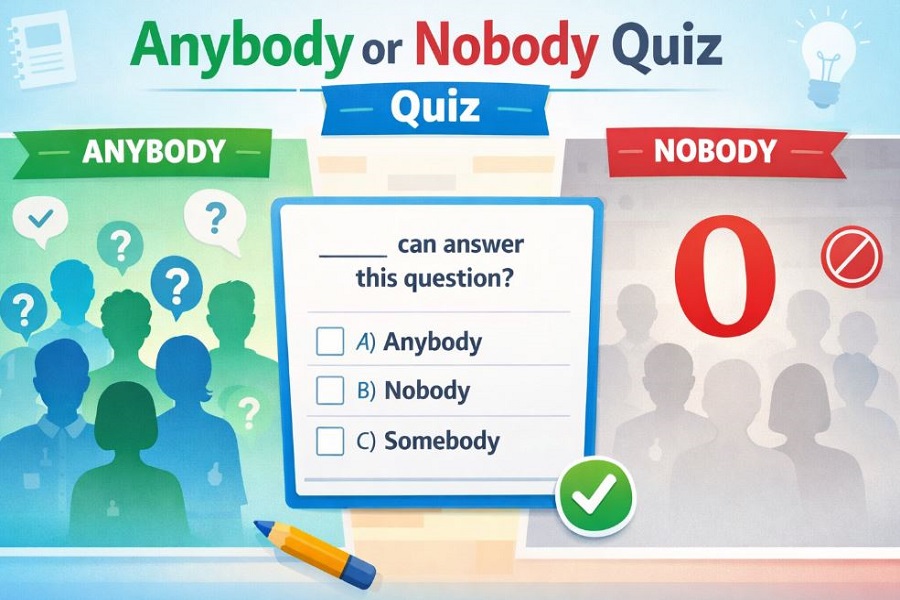
The words “anybody” and “nobody” are common in everyday English, yet they often confuse learners and even native speakers. Both are indefinite pronouns, meaning they refer to people in a general or non-specific way. However, their meanings are opposite.
Understanding the correct use of anybody or nobody is essential for clear communication, grammar accuracy, and strong writing skills—especially in exams, quizzes, and professional content. This guide explains the difference in simple terms and includes interactive MCQs, answers, FAQs, and a clear conclusion to help you master the topic.
What Does “Anybody” Mean?
Anybody refers to any person at all. It is commonly used in:
- Questions
- Negative sentences
- Conditional sentences
- Positive sentences (to emphasize openness or possibility)
Example:
✔ Can anybody help me with this problem?
What Does “Nobody” Mean?
Nobody means no person at all. It already carries a negative connotation and should not be used in conjunction with another negative word.
Example:
✔ Nobody knows the answer.
❌ Nobody doesn’t know the answer. (Incorrect)
Anybody or Nobody: Key Difference
| Word | Meaning | Sentence Type |
|---|---|---|
| Anybody | Any person | Neutral / Open |
| Nobody | No person | Negative |
Anybody or Nobody Quizzes
After giving the test you have to know also what’s the difference between anybody vs nobody with their comparison.
Anybody or Nobody – MCQs (Quizzes)
- _____ can join the meeting if they are interested.
A) Nobody
B) Anybody
C) Somebody - _____ answered the phone when I called.
A) Anybody
B) Nobody
C) Everybody - Is there _____ who can explain this rule?
A) nobody
B) anybody
C) no one - _____ knows what will happen in the future.
A) Anybody
B) Somebody
C) Nobody - I don’t think _____ understands this topic completely.
A) nobody
B) anybody
C) somebody - _____ can make mistakes; it’s human nature.
A) Anybody
B) Nobody
C) No one - There was so much noise that _____ could hear the announcement.
A) anybody
B) somebody
C) nobody - Did _____ leave their bag in the classroom?
A) nobody
B) anybody
C) everyone - _____ is perfect, so don’t blame yourself.
A) Nobody
B) Anybody
C) Somebody - If _____ calls, tell them I’m not available.
A) nobody
B) anybody
C) someone
Answers to Anybody or Nobody MCQs
- B) Anybody
- A) Nobody
- B) Anybody
- C) Nobody
- B) Anybody
- A) Anybody
- C) Nobody
- B) Anybody
- A) Nobody
- B) Anybody
Conclusion
The difference between anybody and nobody may seem small, but it plays a big role in sentence meaning and grammatical accuracy. Anybody keeps the sentence open and neutral, while nobody delivers a strong negative meaning on its own. By practicing examples and quizzes like these, you can avoid common mistakes and speak or write English with greater confidence and clarity.
Mastering anybody or nobody will not only improve your grammar but also help you perform better in exams, interviews, and everyday communication.
FAQs: Anybody or Nobody Quizzes
1. Is “anybody” singular or plural?
Anybody is grammatically singular, but it often uses they/them in modern English for gender neutrality.
2. Can “nobody” be used with “not”?
No. Nobody already has a negative meaning, so using another negative creates a grammatical error.
3. Are “anybody” and “anyone” the same?
Yes. They are interchangeable in most contexts, with no difference in meaning.
4. Why is “anybody” common in questions?
Questions often ask about possibilities, and anybody expresses openness without assuming a negative or positive answer.
5. How can I practice anybody or nobody usage?
Practice by:
- Writing short sentences
- Solving MCQs
- Replacing “somebody” with “anybody” or “nobody” to see how meaning changes