
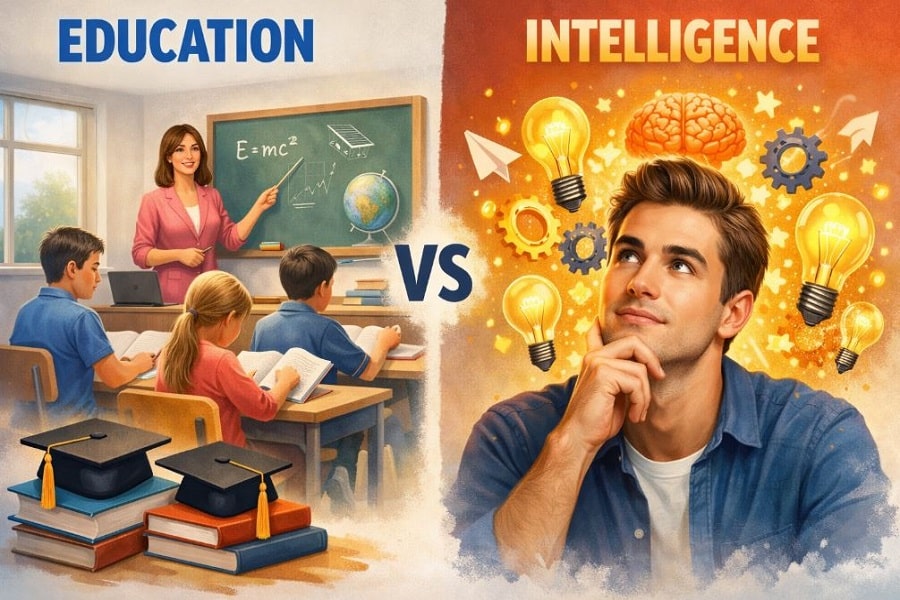
Many people confuse education and intelligence, but they are not the same.
Education is about learning knowledge from schools, books, or courses.
Intelligence is about thinking, solving problems, and understanding ideas.
Understanding the difference helps us see why some educated people struggle in real life, while some less educated people succeed brilliantly.
In this article, you will learn:
The difference between education and intelligence
The types of education
The types of intelligence
How both are important for success
What Is Education?
Education is the process of learning knowledge and skills.
It usually happens in:
Colleges
Universities
Training centers
Education helps people:
Learn facts and concepts
Gain job skills
Understand society and culture
Grow personally and professionally
Types of Education
Formal Education – Schools and colleges with exams and certificates
Informal Education – Learning from family, friends, and life experiences
Non-Formal Education – Workshops, short courses, or skill training
Vocational Education – Job-focused skills like technical or trade training
Online Education – Learning via digital platforms
Lifelong Education – Continuous learning throughout life
Each type helps people grow in different ways.
What Is Intelligence?
Intelligence is the ability to think, understand, and solve problems.
Unlike education, intelligence is not only learned in school. Some people are born intelligent, while others develop it through life and experience.
Types of Intelligence
There are many types of intelligence:
Logical Intelligence: Problem-solving and reasoning
Linguistic Intelligence: Reading, writing, and speaking
Emotional Intelligence (EQ): Understanding emotions
Social Intelligence: Communicating and working with others
Creative Intelligence: Thinking of new ideas
Spatial Intelligence: Understanding visuals and shapes
Physical (Kinesthetic) Intelligence: Using your body skillfully
Musical Intelligence: Understanding music and rhythm
Life requires all types of intelligence, but schools often focus only on academics.
Education vs Intelligence: Key Differences
| Aspect | Education | Intelligence |
|---|---|---|
| Meaning | Learned knowledge | Ability to think and understand |
| Nature | Structured learning | Natural ability |
| Measurement | Exams, degrees | Problem-solving, reasoning |
| Source | Schools and teachers | Brain and experience |
| Certificates | Yes | No |
In simple terms:
Education teaches what to think
Intelligence teaches how to think
How Education and Intelligence Work Together
Education can improve intelligence by teaching critical thinking
Intelligence can enhance education by making learning easier
Together, they are more powerful than one alone
Example: A smart student can learn faster. A good education helps anyone become smarter.
Educated but Not Intelligent vs Intelligent but Not Educated
Educated but Not Intelligent
Some people memorize facts but struggle with:
Real-life decisions
Solving problems
Creativity
This happens when learning focuses only on exams.
Intelligent but Not Educated
Many successful people:
Have no formal degrees
Learn from life experiences
Show strong problem-solving skills
Key point: Intelligence does not need a certificate.
Why Both Matter in Career Success?
Education helps you get opportunities
Intelligence helps you succeed and grow
Employers value:
Problem-solving skills
Emotional intelligence
Adaptability
A mix of both gives long-term success.
Education vs Intelligence in Exams
Exams test education
Aptitude tests test intelligence
Modern education is changing:
Less memorization
More skill-based and problem-solving learning
Which Is More Important?
There is no single answer.
Education gives knowledge and structure.
Intelligence gives thinking and problem-solving
Success comes from using both together
In today’s world, intelligence-based skills are more important than ever.
How Education Can Boost Intelligence?
Education helps intelligence grow when it focuses on:
Thinking critically
Solving real problems
Being creative
Understanding emotions
Applying knowledge in real life
Good education does not limit intelligence. It helps it grow.
Common Myths
Degrees define intelligence
Intelligence cannot change
Education kills creativity
Intelligence can grow
Education should support thinking
Learning never stops
Education and Intelligence Today
Skills matter more than degrees
Thinking matters more than memorization
Lifelong learning is key
Education must adapt to help intelligence grow, not just teach facts.
Pros and Cons of Education and Intelligence
Education
Pros:
Provides structured knowledge
Helps get jobs and opportunities
Builds discipline and work habits
Encourages social interaction
Cons:
Can focus too much on memorization
May not develop practical skills
Not always aligned with creativity or problem-solving
Intelligence
Pros:
Helps solve real-life problems
Encourages creativity and innovation
Adaptable in different situations
Can develop independently of school
Cons:
May not guarantee job opportunities without education
Hard to measure and quantify
Requires self-motivation to grow
Importance of Education
Education is crucial because it has some effective Importance of education:
Gives knowledge about the world
Develops skills for work and life
Shapes values and ethics
Helps society progress
Prepares for higher learning and career growth
Even intelligent people benefit from education because it gives structure and guidance to their natural abilities.
Conclusion
Education vs intelligence is not about choosing one.
Education gives knowledge
Intelligence gives understanding
Together, they lead to real success
Balanced development creates personal growth, career success, and lifelong learning.
FAQs
What is the main difference between education and intelligence?
Education is learned knowledge; intelligence is the ability to think.
Can intelligence exist without education?
Yes, intelligence can exist without formal education.
Is intelligence more important than education?
Both are important in different situations.
What are the types of intelligence?
Logical, emotional, creative, social, linguistic, and more.