
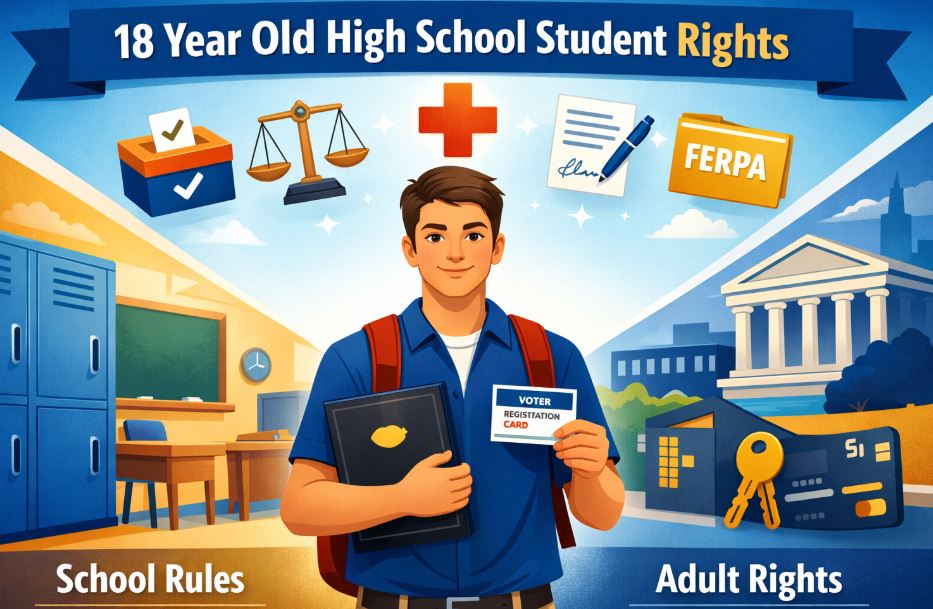
Turning 18 is a major milestone. You can vote, sign contracts, and make your own legal decisions. But what happens if you’re still in high school?
Many students and parents are confused about 18 year old high school student rights. Are you fully independent? Can your parents still control school decisions? Can you leave school without permission?
In this complete guide, we explain the legal rights of an 18 year old high school student in the US in clear, simple terms. You’ll learn what changes legally, what stays the same, and what rights you truly have while finishing high school.
Is an 18 Year Old High School Student Legally an Adult?
Age of Majority in the United States
In most states, 18 is the age of majority. This means you are legally considered an adult.
As an adult, you can:
Vote in elections
Sign contracts
Open a bank account
Make medical decisions
Be legally responsible for your actions
However, being in high school does not reverse your adult status.
Does Being in High School Change Your Legal Status?
No. Once you turn 18, you are legally an adult — even if you are still in 12th grade.
But here’s the important part:
While you are legally an adult, you must still follow school rules and state education laws.
This balance between adult rights and school authority is where most confusion happens.
What Rights Does an 18 Year Old High School Student Have?
If you’re wondering, “What rights does an 18 year old high school student have?” — here’s a clear breakdown.
At 18, you gain:
1. Voting Rights
You can register and vote in local, state, and federal elections.
2. Contract Rights
You can legally:
Sign a lease
Take out a loan
Sign employment contracts
Open credit accounts
3. Medical Decision Rights
You can:
Consent to medical treatment
Refuse medical treatment
Access your own medical records
4. Privacy Rights (FERPA Protection)
At 18, rights under FERPA transfer from parents to you.
This means schools generally need your permission to share academic records.
5. Freedom of Speech
You have First Amendment rights, although schools can place reasonable limits.
6. Legal Responsibility
You are fully responsible for debts, crimes, and contracts you sign.
Constitutional Rights of 18 Year Old High School Students
Even inside a school, you have constitutional protections.
First Amendment: Free Speech & Expression
You have the right to express opinions, but schools may limit speech that:
Disrupts learning
Promotes illegal activity
Threatens safety
You still have more autonomy at 18 compared to minors.
Fourth Amendment: Search and Privacy
Schools can search lockers or property under certain conditions. However:
Searches must be reasonable
Excessive or invasive searches may violate rights
Due Process Rights
If you face suspension or expulsion, you have the right to:
Be informed of the accusation
Respond to charges
Attend a hearing (in serious cases)
Your constitutional rights as an adult still apply in public schools.
Education Rights for 18 Year Old High School Seniors
Public education laws vary by state, but generally:
Right to Continue Education
Most states allow students to stay in high school until age 19–21.
Special Education Protections
If you have an IEP (Individualized Education Program), your rights transfer to you at 18.
Access to Records
You can:
Request transcripts
Review disciplinary records
Control who sees your academic history
Do 18 Year Old High School Students Have Parental Consent Rights?
This is one of the most searched questions online.
Can Parents Still Access School Records?
Once you turn 18, schools usually cannot share grades or records without your consent.
However, exceptions exist if:
Parents claim you as a dependent on taxes
You sign a consent form
Can You Sign Your Own Permission Slips?
Yes. At 18, you can:
Sign field trip forms
Approve school documents
Excuse your own absences (depending on school policy)
Can Parents Still Make Medical Decisions?
Generally, no. Once you turn 18:
You control your medical decisions
Parents cannot override your consent
Voting Rights of 18 Year Old High School Students
You do not have to graduate to vote.
At 18, you can:
Register to vote
Vote in federal, state, and local elections
Serve on a jury (if summoned)
Males must also register with the Selective Service.
Your voting rights begin immediately at 18 — even if you’re still in school.
Can an 18 Year Old High School Student Leave School Without Permission?
This depends on state law.
Compulsory Education Laws
Each state sets a required attendance age. In some states:
Compulsory education ends at 16
In others, it ends at 18
If compulsory education ends at 18 in your state, you may legally withdraw.
Can You Sign Yourself Out of School?
Many schools allow 18-year-olds to:
Sign themselves out
Approve absence forms
Make scheduling decisions
However, school policies may still apply.
Can You Move Out at 18?
Yes, you can legally move out and sign a lease. But practical issues include:
Financial stability
Insurance coverage
School transportation
Legal ability does not always mean financial readiness.
Financial and Legal Responsibilities at 18
Becoming an adult brings freedom — and responsibility.
You can:
Be sued
Be charged as an adult in court
Enter legally binding contracts
Accumulate debt
Before signing anything, understand that contracts are enforceable once you turn 18.
Rights vs Responsibilities: What Changes at 18?
| Area | Before 18 | After 18 |
|---|---|---|
| Voting | Not allowed | Allowed |
| Medical decisions | Parent consent | Self-consent |
| School records | Parent access | Student control |
| Contracts | Limited ability | Full legal power |
State-Specific Differences in 18 Year Old Student Rights
Laws vary by state.
Areas that differ:
Dropout age
Parental financial responsibility
Education extension rights
Dependency laws
Always check your state’s education department website for accurate information.
Read also: How to increase parental involvement in schools?
How to Get an Elementary Teaching Certificate?
Do you know How to Find a Teaching Job?
Apply for a Teaching Certificate?
How Many Years Is a Teaching Degree?
Frequently Asked Questions
Am I legally responsible for myself at 18 in high school?
Yes. You are legally an adult and responsible for your decisions.
Can my school tell my parents my grades if I’m 18?
Usually no, unless you give permission or are claimed as a dependent.
Do I need parental permission at 18 in high school?
In most cases, no — but school policy may still apply.
Can I drop out once I turn 18?
Possibly. It depends on your state’s compulsory attendance law.
Final Thoughts
Turning 18 while still in high school creates a unique situation. You gain adult legal rights, including voting, contracts, medical decisions, and privacy control.
However, you must still follow school rules and state education laws.
Understanding your 18 year old high school student rights helps you make informed decisions as you transition into adulthood.
If you’re unsure about a specific situation, consult your school administration or a local attorney.