
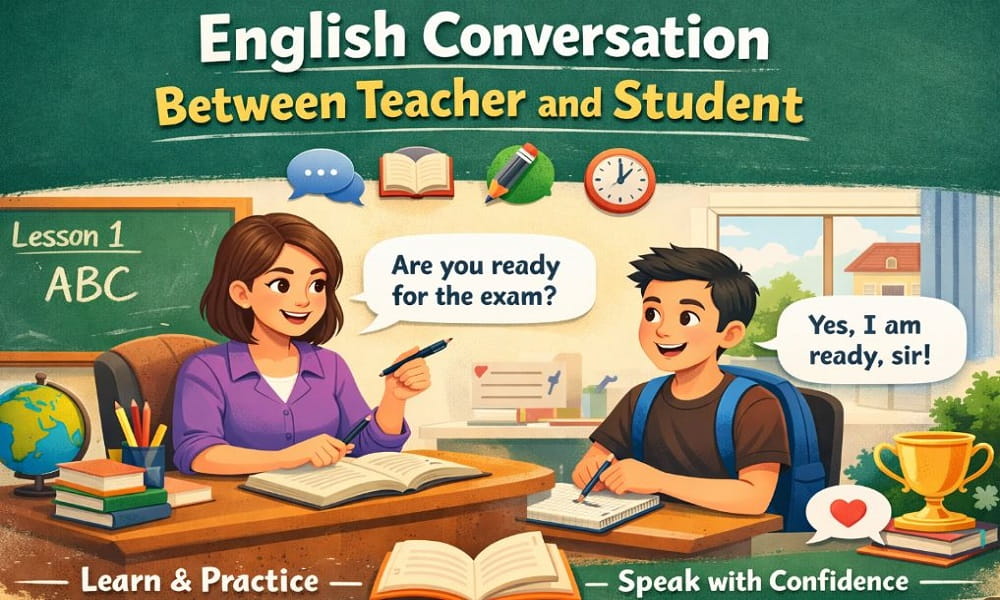
English conversation between teacher and student plays a vital role in improving speaking skills, classroom confidence, and exam performance. Whether you are a beginner learning spoken English or a student preparing for exams, these conversations help you communicate clearly and politely in real-life situations.
In this guide, you will find simple, practical, and easy-to-understand conversations that students commonly use in schools, colleges, and spoken English classes. Each conversation is written in natural English, making it perfect for daily practice.
What Is an English Conversation Between Teacher and Student?
An English conversation between teacher and student is a structured dialogue where both speakers communicate politely and clearly. These conversations usually happen in:
Classrooms
Exam preparation sessions
Spoken English practice
Academic meetings
They help students
Improve pronunciation
Learn polite expressions
Build confidence while speaking English
Simple English Conversation Between Teacher and Student (Beginner Level)
This section is ideal for beginners and school students. You’ll get here the unique English communication between teachers and students.
Conversation 1: Basic Classroom Interaction
Teacher: Good morning. How are you today?
Student: Good morning, sir. I am fine. Thank you.
Teacher: Are you ready for today’s lesson?
Student: Yes, sir. I am ready.
Why this conversation helps:
Uses short sentences
Easy vocabulary
Common classroom phrases
Conversation 2: Asking a Question in Class
Student: Excuse me, ma’am. May I ask a question?
Teacher: Yes, please go ahead.
Student: I didn’t understand the last topic.
Teacher: No problem. I will explain it again.
Key learning points:
Polite expressions
Confidence-building phrases
A Conversation Between the Teacher and the Student About Exam Preparation
This is a high-search-intent topic and very useful for exam candidates.
Conversation 3: Before the Exam
Student: Sir, I am worried about my exams.
Teacher: Why are you feeling nervous?
Student: I haven’t completed my syllabus yet.
Teacher: Make a simple study plan and revise daily. You will do well.
Conversation 4: Discussing Weak Subjects
Teacher: Which subject is difficult for you?
Student: Mathematics is very hard for me.
Teacher: Practice daily and ask questions. Improvement takes time.
Exam-related benefits:
Reduces exam fear
Encourages positive thinking
Builds communication skills
Conversation 5: After Poor Exam Results
Student: I didn’t score well in the exam.
Teacher: Don’t lose hope. Learn from your mistakes.
Student: How can I improve next time?
Teacher: Focus on basics and practice regularly.
Conversation Between Teacher and Student After a Long Time
This conversation is useful for real-life English practice.
Conversation 6: Meeting After Many Years
Student: Good afternoon, sir. Do you remember me?
Teacher: Yes, of course! How have you been?
Student: I am doing well. I am working now.
Teacher: That’s wonderful. I am proud of you.
Why learners love this section:
Emotional connection
Real-life English
Natural conversation flow
Formal vs Simple English Conversation (Quick Comparison)
| Simple English | Formal English |
|---|---|
| Can I ask a question? | May I ask you a question, sir? |
| I don’t understand | I’m having difficulty understanding |
| Thank you | I appreciate your help |
Common Vocabulary Used in Teacher–Student Conversations
Classroom Words
Homework
Lesson
Assignment
Attendance
Exam-Related Words
Revision
Syllabus
Result
Performance
Polite Expressions
May I
Excuse me
Thank you
Please
Tips to Practice English Conversation Effectively
To improve faster, follow these simple tips:
Practice role-play with a friend
Read conversations aloud
Record your voice and listen
Speak slowly and clearly
Practice daily for 10–15 minutes
Common Mistakes Students Make While Speaking English
Many students struggle because they:
Fear making mistakes
Use very long sentences
Avoid asking questions
Focus too much on grammar
Remember: Clear communication is more important than perfect grammar.
FAQs – English Conversation Between Teacher and Student
Is this helpful for spoken English exams?
Yes, these conversations are perfect for viva and oral exams.
Can beginners use these conversations?
Absolutely. They are written in simple English.
How often should students practice English conversation?
Daily practice is best, even for a short time.
Conclusion
English conversation between teacher and student is one of the most effective ways to improve spoken English, exam confidence, and classroom communication. By practicing these simple and real-life dialogues daily, students can speak English naturally and without fear.