
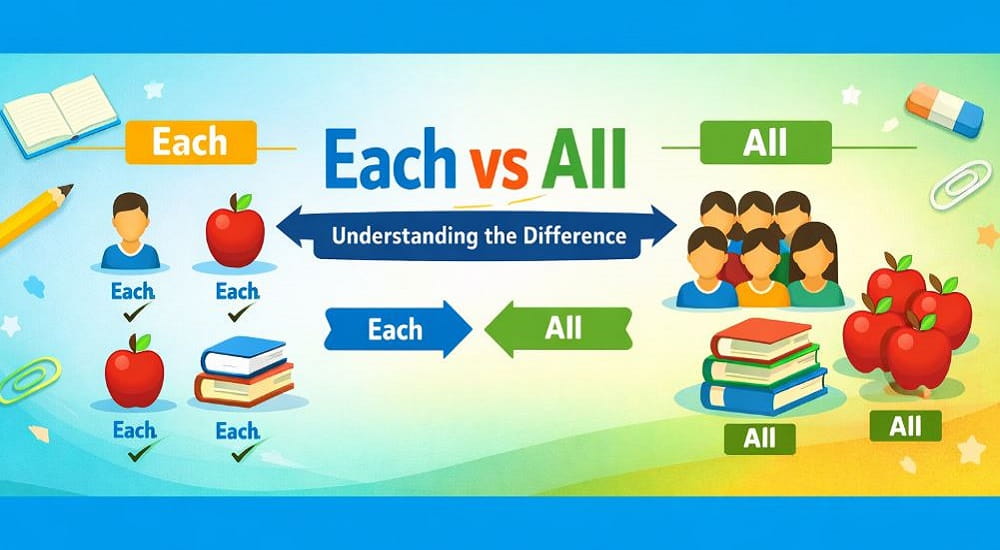
Understanding the difference between each vs all is an important part of learning English grammar. These two words look simple, but many learners confuse them because both refer to groups of people or things. However, they are used in different ways and carry slightly different meanings.
In simple terms, each focuses on individuals in a group, while all refers to the whole group together. Knowing when to use these words correctly can improve your writing, speaking, and grammar accuracy.
In this detailed guide, you will learn:
The meaning of each and all
The difference between each and all
Practical each and all examples
Common mistakes learners make
A helpful each and all exercise to test your knowledge
By the end of this article, you will clearly understand how to use these two words correctly in everyday English.
What Does “Each” Mean in English Grammar?
The word each is used when we talk about individual members of a group separately. Even though we are referring to a group, the focus is on one person or thing at a time.
Because of this, each is usually followed by a singular noun and a singular verb.
Key rule:
Each + singular noun + singular verb
Example Sentences Using “Each”
Each student has a notebook.
Each player receives a uniform.
Each book belongs to the library.
Each child was given a toy.
In all of these sentences, we are thinking about every individual member separately, not the group as a whole.
When Do We Use “Each”?
We typically use each in the following situations:
1. When focusing on individuals
Example:
Each employee received a bonus.
2. When distributing things one by one
Example:
The teacher gave each student a worksheet.
3. When the group is small
Example:
Each of the two friends brought a gift.
4. When describing personal responsibility
Example:
Each member must complete the task.
Using each helps emphasize individuality and personal attention.
What Does “All” Mean in English Grammar?
The word all refers to the entire group together. Instead of focusing on individuals separately, it talks about the whole group collectively.
Unlike each, the word all can be used with plural nouns or uncountable nouns.
Examples of “All” in Sentences
All students passed the exam.
All the books are on the table.
All players celebrated the victory.
All the water in the bottle is gone.
Here, we are referring to everything or everyone together, not separately.
When Do We Use “All”?
We commonly use all in the following situations:
1. Talking about an entire group
Example:
All students must attend the meeting.
2. Referring to total quantities
Example:
All the milk has been used.
3. Making general statements
Example:
All humans need food and water.
4. Describing shared experiences
Example:
All participants enjoyed the event.
In these examples, the focus is on the group as a whole.
Each vs All – Key Differences Explained
Now let’s clearly understand the difference between each and all.
1. Meaning Difference
Each focuses on individual members in a group.
Example:
Each student has a book.
All focuses on the entire group together.
Example:
All students have books.
2. Grammar Structure
Each usually follows this structure:
Each + singular noun + singular verb
Example:
Each student has a pencil.
All often follows this structure:
All + plural noun + plural verb
Example:
All students have pencils.
3. Emphasis in Meaning
Each emphasizes individual attention.
Example:
Each child received a medal.
All emphasizes group unity.
Example:
All children received medals.
Difference Between Each and All (Comparison Table)
| Feature | Each | All |
|---|---|---|
| Meaning | Refers to individuals in a group | Refers to the entire group |
| Verb Form | Singular verb | Singular or plural depending on noun |
| Focus | Individual members | Whole group |
| Example | Each student has a book | All students have books |
Each and All Examples in Everyday English
Learning through examples makes grammar easier to understand.
Examples Using “Each”
Each teacher prepared a lesson plan.
Each passenger received a ticket.
Each player practiced before the match.
Each student completed the assignment.
These sentences emphasize one person at a time.
Examples Using “All”
All teachers attended the meeting.
All passengers boarded the plane.
All players celebrated the victory.
All students completed the assignment.
These examples describe the group collectively.
When to Use Each vs All (Practical Tips)
Here are some simple tips to help you choose the correct word.
Use “Each” When:
You want to focus on individuals
The group is small
Items are distributed one by one
Personal responsibility is emphasized
Example:
Each contestant must answer the question.
Use “All” When:
Talking about the whole group
Making general statements
Referring to large numbers
Describing collective actions
Example:
All contestants answered the question.
Common Mistakes When Using Each and All
Many English learners make mistakes when using each and all. Here are some common errors.
Incorrect Verb Agreement
Incorrect:
Each students have a book.
Correct:
Each student has a book.
Incorrect:
All student has a book.
Correct:
All students have books.
Confusing “Each” With “Every”
While similar, each focuses on individuals separately, while every refers to all members collectively.
Example:
Each student received a certificate.
Every student received a certificate.
The meaning is similar but the emphasis is different.
Each and All Exercise (Practice Questions)
Try these exercises to test your understanding.
Fill in the Blanks
______ student must complete the test.
______ players celebrated the win.
The teacher spoke to ______ child individually.
______ books on the shelf belong to the library.
Multiple Choice Questions
______ person received a gift.
a) Each
b) All
______ the students passed the exam.
a) Each
b) All
The teacher gave ______ student a worksheet.
a) Each
b) All
Practice also: Each or Both quiz
Answers
Each
All
Each
All
Practicing exercises like these helps reinforce the difference between each and all.
Quick Summary of Each vs All
Let’s review the key points.
Each refers to individuals within a group
All refers to the entire group collectively
Each uses singular nouns and verbs
All often uses plural nouns and verbs
Each emphasizes individuality
All emphasizes group unity
Understanding this difference will help you write clearer and more accurate English sentences.
FAQs About Each vs All
What is the difference between each and all?
Each focuses on individual members of a group, while all refers to the entire group collectively.
Can “each” be used with plural nouns?
No. Each is usually followed by a singular noun and singular verb.
Example:
Each student has a notebook.
Is “all” singular or plural?
All can be singular or plural, depending on the noun used.
Example:
All the water is gone.
All students are ready.
Which is correct: each student or all students?
Both are correct, but they emphasize different meanings.
Each student = focusing on individuals
All students = focusing on the group
When should I use each instead of all?
Use each when you want to emphasize individual responsibility or attention within a group.
Conclusion
The difference between each vs all may seem small, but it plays an important role in English grammar. Each focuses on individuals within a group, while all refers to the entire group together.
By understanding these rules, reviewing examples, and practicing exercises, you can easily master the correct usage of these words. Over time, this knowledge will help you communicate more clearly and confidently in English.