
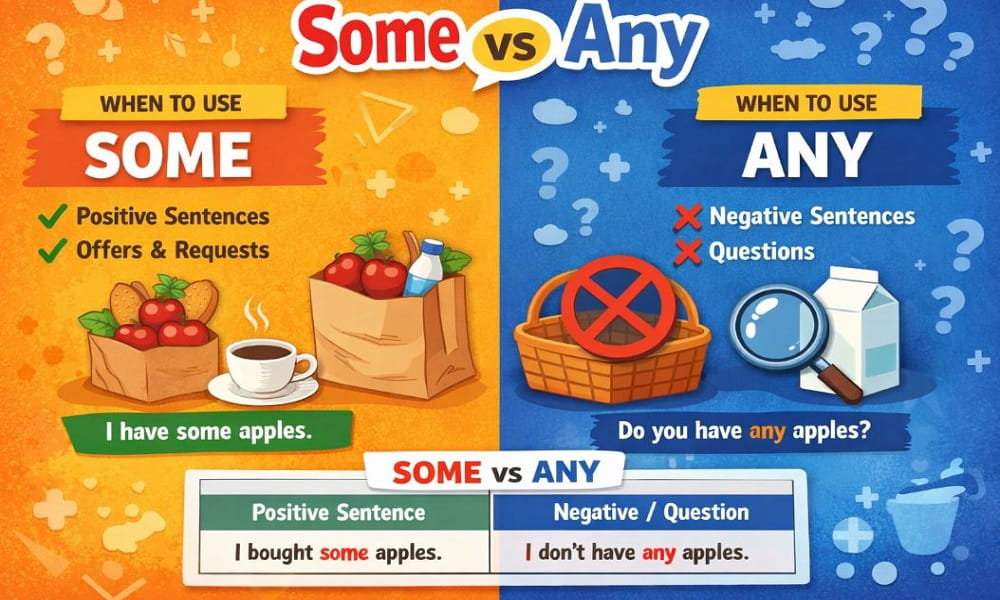
Understanding Some vs Any is an essential part of learning English grammar. Many learners struggle to know when to use some and when to use any, especially in questions and negative sentences. However, once you understand the rules, using these words becomes much easier.
Both some and any are called quantifiers or determiners. They help us talk about an unspecified amount or number of something. These words are commonly used with countable nouns (like apples, books, friends) and uncountable nouns (like water, milk, money).
In this complete guide, you will learn:
The difference between some and any
When to use some and any
Real-life some vs any examples
A simple some vs any comparison chart
Practice some vs any exercises
By the end of this guide, you will clearly understand how to use some and any correctly in English sentences.
What Are “Some” and “Any” in English Grammar?
Before comparing some vs any, it is important to understand what these words mean.
What Is “Some”?
The word some refers to an unspecified amount or number of something. It is mostly used in positive sentences, offers, and requests.
Examples:
I bought some apples from the market.
She has some friends in Canada.
There is some milk in the fridge.
In these sentences, the exact number or amount is not important.
What Is “Any”?
The word any also refers to an unspecified quantity, but it is generally used in negative sentences and questions.
Examples:
I don’t have any money.
Do you have any questions?
There isn’t any sugar left.
Here, any emphasizes the absence or possibility of something.
The Main Difference Between Some and Any
The difference between some and any mainly depends on the type of sentence.
Basic Rule
Some → Positive sentences
Any → Negative sentences and questions
Examples:
Positive sentence:
I have some books.
Negative sentence:
I don’t have any books.
Question:
Do you have any books?
However, English grammar also has exceptions, which we will discuss later.
Some vs Any Comparison Chart
The following some vs any comparison chart makes it easier to understand their differences.
| Feature | Some | Any |
|---|---|---|
| Sentence Type | Positive sentences | Negative sentences and questions |
| Meaning | A certain amount or number | Not specific amount |
| Countable Nouns | Yes | Yes |
| Uncountable Nouns | Yes | Yes |
| Example | I bought some apples | I don’t have any apples |
This chart helps beginners quickly understand the difference between some and any.
When to Use “Some”
1. Some in Positive Sentences
The most common use of some is in affirmative (positive) sentences.
Examples:
I have some friends in London.
She bought some vegetables yesterday.
We need some water for the trip.
They found some interesting ideas.
In all these examples, the sentence is positive and refers to an unspecified quantity.
2. Some in Offers
In English, some is often used in offers.
Examples:
Would you like some coffee?
Can I get you some tea?
Would you like some cake?
Although these are questions, some is used because the speaker expects the answer to be yes.
3. Some in Requests
We also use some when making polite requests.
Examples:
Could you give me some help?
May I have some sugar?
Can you lend me some money?
Using some in requests sounds more polite and natural.
When to Use “Any”
1. Any in Negative Sentences
The most common rule is that any is used in negative sentences.
Examples:
I don’t have any money.
She didn’t buy any fruit.
There isn’t any water in the bottle.
We don’t have any plans today.
These sentences express absence or zero quantity.
2. Any in Questions
We usually use any when asking questions.
Examples:
Do you have any questions?
Is there any milk in the fridge?
Are there any restaurants nearby?
Did you buy any groceries?
In questions, any means it does not matter which or how many.
3. Any in Conditional Sentences
Any is also common in conditional sentences.
Examples:
If you need any help, call me.
If you have any questions, please ask.
Let me know if there are any problems.
This usage suggests possibility.
Read and practice also related topics: Each vs Both
Some vs Any Examples in Sentences
Looking at some vs any examples helps learners understand their real use.
Positive Sentences
I bought some apples.
She has some great ideas.
We need some information.
Negative Sentences
I don’t have any apples.
She doesn’t have any free time.
There isn’t any milk left.
Questions
Do you have any brothers?
Are there any buses today?
Would you like some tea?
Notice that some appears in the last example because it is an offer.
Some vs Any with Countable and Uncountable Nouns
Both some and any can be used with countable and uncountable nouns.
Countable Nouns
Examples:
some books
some students
any books
any students
Example sentences:
I bought some books.
I didn’t buy any books.
Uncountable Nouns
Examples:
some water
some sugar
any water
any sugar
Example sentences:
There is some water in the glass.
There isn’t any sugar left.
Common Mistakes with Some and Any
Many English learners make simple mistakes with some vs any.
Mistake 1: Using Some in Negative Sentences
Incorrect:
I don’t have some money.
Correct:
I don’t have any money.
Mistake 2: Using Any in Positive Sentences
Incorrect:
I bought any apples.
Correct:
I bought some apples.
Mistake 3: Confusing Questions and Offers
Incorrect:
Would you like any coffee?
Correct:
Would you like some coffee?
Some vs Any Exercises
Practice helps you master grammar. Try these some vs any exercises.
Fill in the blanks
I need ______ help.
Do you have ______ pencils?
She bought ______ bread.
I don’t have ______ money.
Would you like ______ tea?
Answers:
some
any
some
any
some
Multiple Choice
Do you have (some / any) idea?
I bought (some / any) apples.
There isn’t (some / any) water left.
Would you like (some / any) coffee?
Answers:
any
some
any
some
Quick Rules to Remember
Here are simple rules to remember the difference between some and any:
Use some in positive sentences.
Use any in negative sentences.
Use any in most questions.
Use some in offers and requests.
Remembering these four rules will help you avoid most mistakes.
FAQs About Some vs Any
What is the difference between some and any?
The main difference is that some is usually used in positive sentences, while any is used in negative sentences and questions.
Example:
I bought some apples.
I didn’t buy any apples.
Can we use some in questions?
Yes. We use some in questions when making offers or requests.
Example:
Would you like some tea?
Can we use any in positive sentences?
Yes, but it is less common. Sometimes any is used to mean no limit.
Example:
You can choose any book you like.
Conclusion
Learning the difference between some and any is an important step toward mastering English grammar. These two small words are used very frequently in everyday conversations.
To summarize:
Some is mostly used in positive sentences, offers, and requests.
Any is mainly used in negative sentences, questions, and conditional sentences.
By practicing some vs any examples and completing some vs any exercises, you will quickly become confident in using these words correctly.
The key to mastering English grammar is consistent practice and real-life usage.