
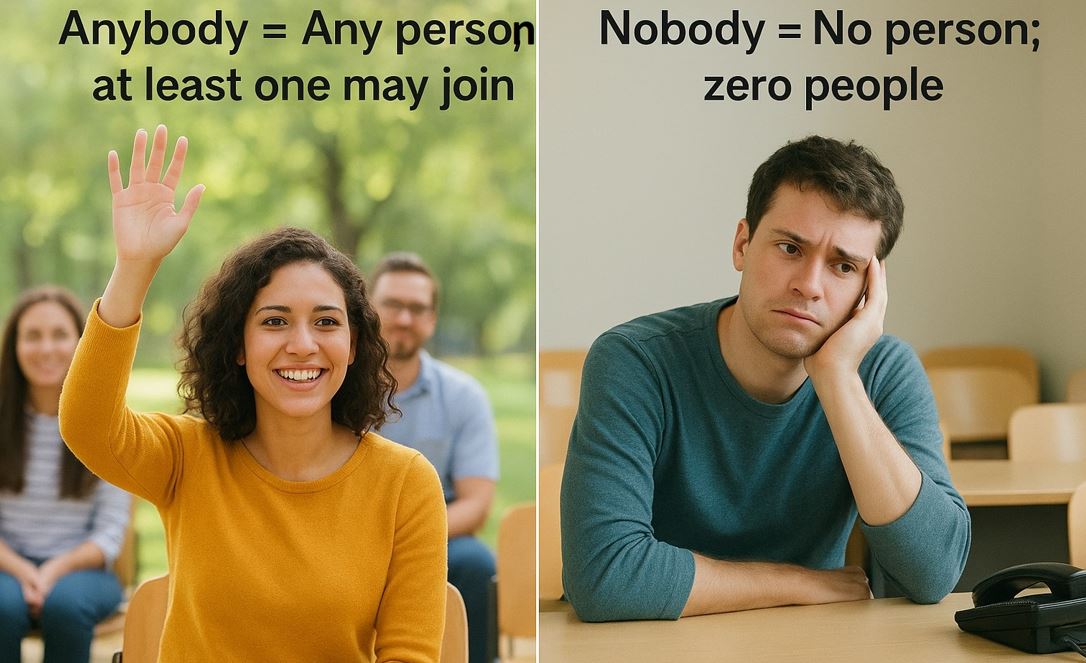
Understanding the difference between “anybody” and “nobody” is an important step toward improving your English communication skills. These two simple words may look similar, but they express completely opposite ideas. “Anybody” opens possibilities and includes all people, while “nobody” shuts the door to all possibilities by referring to zero people.
English learners often get confused because both words appear in questions, daily conversations, and even formal writing. Knowing when to use each one helps you avoid misunderstandings and makes your language clearer and more professional.
In this guide, you’ll learn the definitions, meanings, examples, and correct usage of both words in a simple and friendly way. You’ll also find common mistakes to avoid, along with helpful exercises to practice what you learn. By the end, you’ll be confident using “anybody” and “nobody” correctly in real-life sentences. Let’s begin your quick and easy English grammar improvement journey!
What Does “Anybody” Mean?
Definition of Anybody:
“Anybody” is an indefinite pronoun used to refer to any one person. It does not point to a specific individual.
Meaning in Simple Words:
Anybody = Any person; it could be one, or it could be many—we don’t know who.
Examples of Anybody in Sentences:
- Anybody can enter the competition.
- Did anybody call me today?
- Is anybody sitting here?
Where We Use “Anybody”:
- Questions: Is anybody home?
- Offers: Anybody can join us.
- Possibilities: Anybody can learn new skills.
- Conditions: If anybody needs help, ask me.
What Does “Nobody” Mean?
Definition of Nobody:
“Nobody” is an indefinite pronoun meaning no person or not a single individual.
Meaning in Simple Words:
Nobody = No one at all. Zero people.
Examples of Nobody in Sentences:
- Nobody was in the classroom.
- Nobody knows the truth.
- I invited everyone, but nobody came.
Where We Use “Nobody”:
- Negative statements: Nobody answered the phone.
- To show absence: Nobody lives in that house now.
- To show emptiness: Nobody wanted the extra work.
Anybody vs Nobody: What’s the Difference?
Here is the difference in the simplest form:
| Word | Meaning | Type | Example |
| Anybody | Any person | Neutral | Anybody can try. |
| Nobody | No person | Negative | Nobody tried. |
Simple Explanation:
- Anybody = at least one person might
- Nobody = not even one person
Comparison Example:
- Anybody can help you. → It is possible someone will help.
- Nobody helped you. → No one helped at all.
Correct Usage of “Anybody”
Use anybody when you want to express possibility, openness, or uncertainty.
Correct Usage Examples:
- Does anybody want tea?
- Anybody is welcome to join the event.
- I don’t think anybody saw me leave.
Important Note
“Anybody” is not negative by itself.
The sentence may be negative because of other words like don’t, didn’t, can’t, etc.
Correct Usage of “Nobody”
Use nobody when you want to show zero people, absence, or complete negation.
Correct Usage Examples:
- Nobody came to the meeting.
- Nobody can solve this puzzle.
- Nobody was ready to leave early.
Grammar Rule: Do Not Use Double Negatives
“Nobody” is already negative, so avoid adding don’t, didn’t, or not before it.
Nobody didn’t see it.
lass=”yoast-text-mark” />> Nobody saw it.
Common Mistakes with Anybody vs Nobody
Using Double Negatives with “Nobody”
Incorrect: Nobody didn’t know the answer.
Correct: Nobody knew the answer.
Using “Anybody” When You Mean “Nobody”
Incorrect: Anybody was not there.
Correct: Nobody was there.
Mixing “Somebody,” “Anybody,” and “Nobody”
Incorrect: Anybody stole my wallet.
Correct: Somebody stole my wallet.
Examples of Anybody vs Nobody in Daily Life
Anybody Examples:
- Can anybody hear me?
- If anybody needs directions, ask me.
- I wonder if anybody is home.
Nobody Examples:
- Nobody remembered my birthday.
- There was nobody at the park.
- Nobody believed the rumor.
Exercises: Practice Using Anybody and Nobody
Fill in the blanks with anybody or nobody.
Exercise 1: Fill in the Blanks
- _______ knows where the keys are.
- Is _______ sitting here?
- _______ wanted to go out in the rain.
- If _______ calls, tell me immediately.
- _______ helped her carry the bags.
Answers:
- Nobody
- Anybody
- Nobody
- Anybody
- Nobody
Extra Related Words (Helpful for Learning)
Similar Words to “Anybody”:
- Anyone
- Whoever
- Any person
Similar Words to “Nobody”:
- No one
- Not a single person
- None
These synonyms help you understand the meanings more clearly and expand vocabulary.
Frequently Asked Questions (FAQs): Anybody vs Nobody
What is the main difference between “anybody” and “nobody”?
The main difference is the meaning:
- Anybody means any person.
- Nobody means no person.
One is neutral, the other is negative.
Is “nobody” singular or plural?
“Nobody” is singular, so it takes a singular verb.
Example: Nobody knows the answer.
Can I use “nobody” in a question?
Usually no.
In questions, we use anybody instead.
Example: Is anybody there?
(NOT: Is nobody there?)
Is it wrong to say “nobody didn’t”?
Yes, it is incorrect because it creates a double negative.
Correct form: Nobody did.
When should I use “anybody” instead of “somebody”?
Use anybody when you mean any person at all, especially in questions and possibilities.
Use somebody when you mean one specific but unknown person.
Can “anybody” mean “everybody”?
No. “Anybody” refers to any one person, not everyone.
Example: Anybody can join means it’s possible for any individual to join, not that everyone must join.
Is “nobody” a polite word?
Yes, it is neutral and polite in most cases.
Example: Nobody answered the door.
Are “anybody,” “nobody,” and “somebody” interchangeable?
No. They express different meanings:
- Anybody = any person
- Somebody = one unknown person
- Nobody = no person
Can I use “anybody” in formal writing?
Yes, anybody is acceptable in both formal and informal writing.
Example: Anybody with experience may apply.
Can “anybody” be used in positive and negative sentences?
Yes! Anybody is neutral by itself. In positive sentences, it shows possibility (e.g., Anybody can join the class). In negative sentences, the negative meaning comes from words like don’t or didn’t (e.g., I don’t think anybody is home).
Try to read also: Anybody VS Anyone with their differences
Why is “nobody” considered singular?
Nobody refers to no person at all, so it always takes a singular verb.
Example: Nobody knows the answer (not “know”). Using a plural verb with “nobody” is grammatically incorrect.
Can “anybody” and “somebody” be used interchangeably?
Not really. Anybody refers to any person at all (possibility), while somebody refers to one specific but unknown person.
Example:
- Anybody can answer → anyone might answer.
- Somebody answered → one person answered, but we don’t know who.
Is it correct to say “nobody didn’t”?
No. Saying “nobody didn’t” creates a double negative, which is grammatically wrong. The correct form is simply nobody did.
Example:
Nobody didn’t come.
Nobody came.
Can I use “nobody” in questions?
Usually, no. In questions, we use anybody instead because it expresses possibility.
Example:
Is anybody there?
Is nobody there? (sounds unusual in standard English)
Conclusion
Understanding the difference between “anybody” and “nobody” is a simple step that can make a big difference in your English communication. These two small words express completely opposite ideas, and using them correctly helps you speak and write with clarity and confidence.
Whether you’re asking a question, describing a situation, or expressing a negative idea, choosing the right pronoun makes your message clear and accurate. With the definitions, examples, and exercises in this guide, you can now use “anybody” and “nobody” naturally in everyday conversations.
Keep practicing, and you’ll notice your English becoming smoother, clearer, and more professional.