
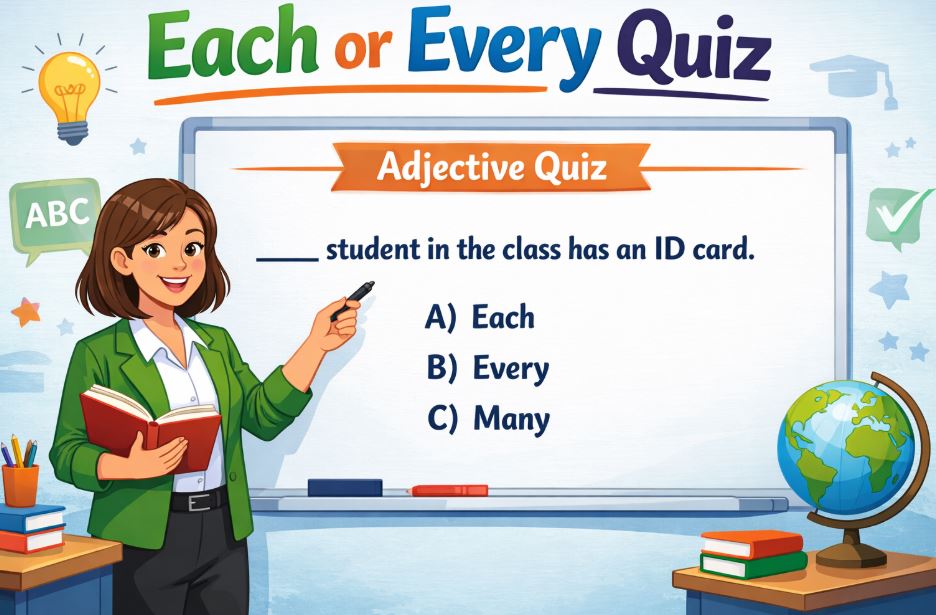
Understanding the difference between “each” and “every” is essential for writing and speaking correct English. Although both words are used to talk about individual people or things in a group, their meanings and usage are not always the same. This Each or Every quiz will help learners clearly understand the rules through simple explanations and practice questions.
Whether you are a student, teacher, or English learner preparing for exams, this guide will strengthen your English grammar skills step by step.
What Is the Difference Between Each and Every?
Use of Each
- Refers to individual items separately
- Emphasizes one by one
- Can be used for two or more people or things
Example:
- Each student received a certificate.
Use of Every
- Refers to all items together as a group
- Emphasizes completeness
- Usually used for three or more items
Example:
- Every student must wear a uniform.
Each or Every Quiz Test
Each or Every Quiz (MCQs)
Choose the correct option in each question.
01. ___ student in the class has an ID card.
A) Each
B) Every
C) Many
02. The teacher spoke to ___ child individually.
A) Each
B) Every
C) All
03. ___ morning, she goes for a walk.
A) Each
B) Every
C) Some
04. There are two bags, and ___ bag is heavy.
A) Each
B) Every
C) All
05. ___ player must follow the rules of the game.
A) Each
B) Few
C) Every
06. I checked ___ answer carefully.
A) Every
B) Each
C) Much
07. ___ one of the apples was fresh.
A) Every
B) Each
C) Many
08. She visits her grandparents ___ weekend.
A) Every
B) Each
C) All
09. The prizes were given to ___ participant.
A) Every
B) Each
C) Some
10. ___ of the twins looks exactly the same.
A) Every
B) Few
C) Each
Quiz Answers (All Together)
- B) Every
- A) Each
- B) Every
- A) Each
- C) Every
- B) Each
- B) Each
- A) Every
- B) Each
- C) Each
Frequently Asked Questions (FAQs)
Can “each” and “every” be used interchangeably?
Not always. While both refer to individuals, “each” focuses on individuals separately, whereas “every” focuses on the group as a whole.
Which one is used for two items?
“Each” can be used for two items, but “every” is usually not used for just two.
Is the verb singular after each and every?
Yes. Both each and every are followed by a singular verb.
Example:
- Each student is present.
- Every child needs care.
Can we use “each of” and “every of”?
- Each of is correct.
- Every of is incorrect.
Example:
False: Each of the boys
Error: Every of the boys
Which is more common in daily English?
“Every” is more common in general statements, while “each” is more common in formal or detailed contexts.
Conclusion
Mastering the difference between each and every can greatly improve your English grammar accuracy. This Each or Every quiz helps you understand not only the rules but also how to apply them in real sentences. Regular practice with quizzes like these builds confidence and prepares learners for school exams, competitive tests, and everyday communication.
Keep practicing, and soon choosing between each and every one will feel natural and easy!