
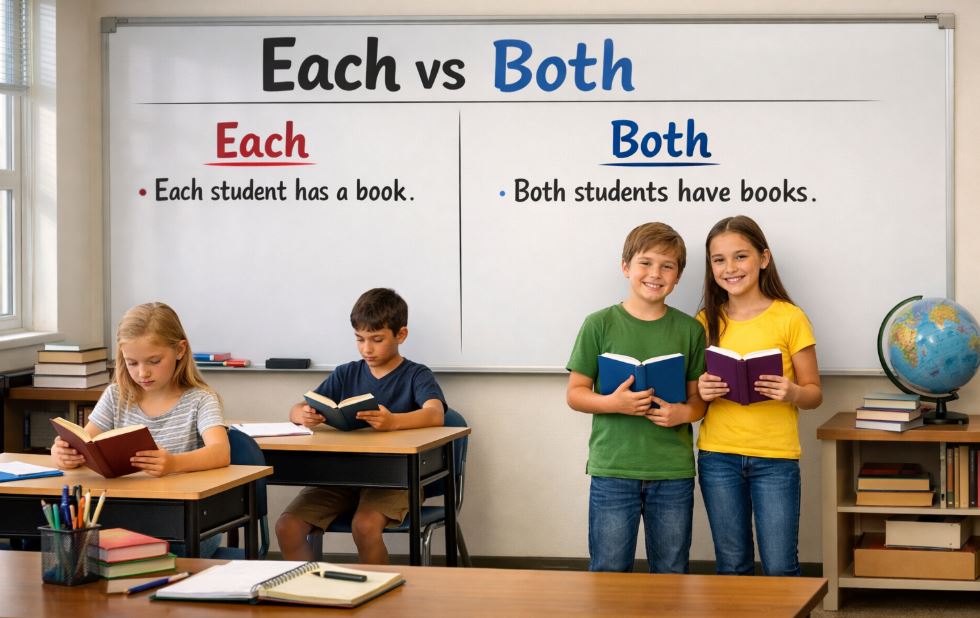
Understanding Each vs Both is important for writing and speaking correct English. Many learners confuse these two words because they both talk about people or things in a group. However, their meanings and grammar rules are different.
In this complete guide, you will learn:
What “each” means
What “both” means
What is the difference between each and both
Each vs both sentences
Each vs both examples
Each vs both exercises
Each vs both quiz
Let’s start with the basics.
What Is the Meaning of “Each”?
Definition of Each
“Each” refers to every individual person or thing in a group. It focuses on one item at a time.
Even if there are two, three, or more items, “each” looks at them separately.
Simple Idea:
Each = one by one
Examples:
Each student has a book.
Each player received a medal.
Each child is happy.
Notice something important:
The verb after “each” is singular.
Grammar Rules for “Each”
Here are the main rules:
1. Each + Singular Noun
Each student is ready.
Each car has a number.
2. Each of + Plural Noun/Pronoun
Each of the students is ready.
Each of them is happy.
Even though the noun is plural, the verb remains singular.
Correct: Each of the players is here.
Incorrect: Each of the players are here.
What Is the Meaning of “Both”?
Definition of Both
“Both” refers to two people or two things together.
It talks about them as a pair, not separately.
Simple Idea:
Both = the two together
Examples:
Both students are present.
Both dogs are barking.
Both answers are correct.
Notice the difference:
The verb after “both” is plural.
Grammar Rules for “Both”
1. Both + Plural Noun
Both teachers are kind.
Both books are interesting.
2. Both of + Object Pronoun
Both of them are ready.
Both of us are tired.
The verb is always plural with “both.”
Correct: Both of the boys are playing.
Incorrect: Both of the boys is playing.
What Is the Difference Between Each and Both?
This is the most important part of the guide.
Core Difference
| Feature | Each | Both |
|---|---|---|
| Meaning | One by one | Two together |
| Number | Two or more | Only two |
| Verb Type | Singular verb | Plural verb |
| Focus | Individual | Pair |
Simple Explanation
“Each” focuses on individuals.
“Both” focuses on two items together.
Side-by-Side Examples
Each student received a certificate.
(One student at a time)Both students received certificates.
(The two students together)
Another example:
Each child has a toy.
Both children have toys.
Now you can clearly see the difference between each and both.
Each vs Both in Sentences
Here are more comparisons to help you understand clearly:
Each girl is wearing a dress.
Both girls are wearing dresses.Each answer is correct.
Both answers are correct.Each employee has an ID card.
Both employees have ID cards.
Notice:
Each → singular noun + singular verb
Both → plural noun + plural verb
Each of Both Meaning – Is It Correct?
Many learners ask about “each of both meaning.”
The truth is:
Wrong: “Each of both” is grammatically incorrect.
You cannot use “each” and “both” together like this.
Instead, say:
Each of the two students is ready.
Both students are ready.
Do not combine them.
Common Mistakes Learners Make
Here are frequent errors:
1. Wrong Verb Agreement
Wrong: Each of them are here.
Right: Each of them is here.
Wrong: Both of them is ready.
Right: Both of them are ready.
2. Using Both for More Than Two
Wrong: Both of the three students are here.
Right: Use “all” instead.
3. Using Each as Plural
Wrong: Each students are ready.
Right: Each student is ready.
Each vs Both Examples (Advanced Usage)
In Conversation
Each of us has a role to play.
Both of us agree with you.
For Academic Writing
Each participant was interviewed.
Both theories are valid.
In Professional Context
Each employee must sign the form.
Both managers approved the decision.
Each vs Both Exercises
1. Exercise
Fill in the blanks
______ student has a notebook.
______ of them are friends.
______ of the players is ready.
______ teachers are present.
2. Exercise
Choose the correct word
(Each/Both) child has a toy.
(Each/Both) girls are sisters.
(Each/Both) of them is correct.
(Each/Both) answers are right.
Exercise Answers
Each
Both
Each
Both
Each vs Both Quiz
Multiple Choice Questions
Each of the students ___ present.
a) are
b) isBoth of the boys ___ playing.
a) is
b) areEach teacher ___ responsible.
a) are
b) isBoth answers ___ correct.
a) is
b) are
Quiz Answers
b) is
b) are
b) is
b) are
Read also more related topics: Each VS Every
Quick Summary: Each vs Both
Each = one by one
Both = two together
Each uses singular verbs
Both uses plural verbs
“Each of both” is incorrect
If you remember just one rule:
Each = individual
Both = pair
Frequently Asked Questions
What is the difference between each and both?
“Each” focuses on individuals and uses a singular verb. “Both” refers to two items together and uses a plural verb.
Can we use each for two people?
Yes. You can say:
Each of the two boys is ready.
Is “each of both” correct?
No, it is grammatically incorrect.
Do we use singular or plural verbs with each?
Singular verbs.
Do we use singular or plural verbs with both?
Plural verbs.
Conclusion
Now you fully understand Each vs Both, including meanings, grammar rules, examples, exercises, and quiz practice.
Keep practicing by writing your own each vs both sentences. The more you practice, the more confident you will become.