
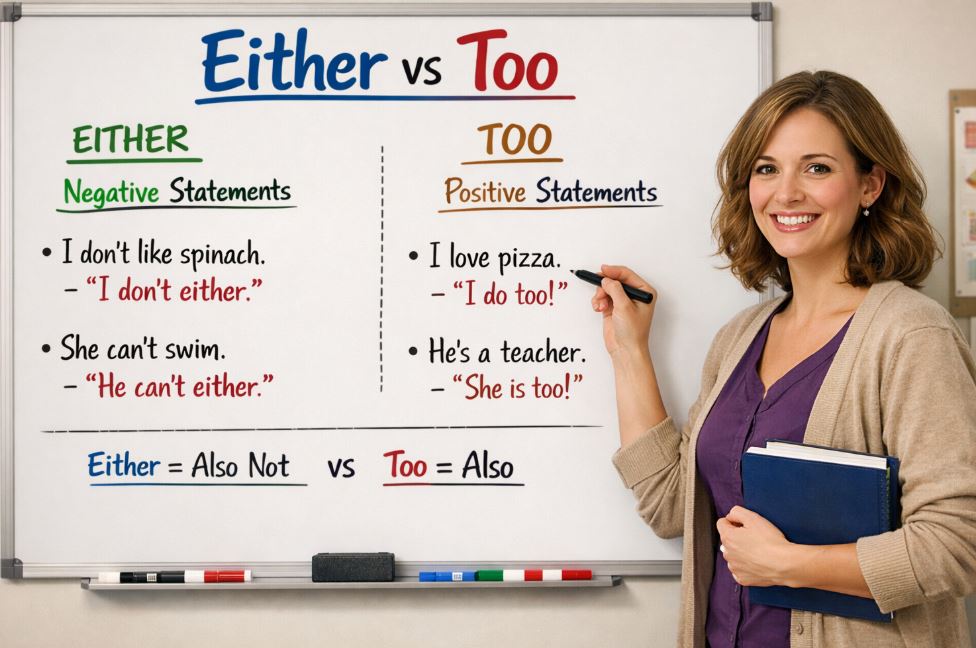
Understanding the difference between either vs too is one of the most common challenges in English grammar. Many learners confuse these two small words because both are used to show agreement. Either and too are not interchangeable, and using the wrong one can make a sentence sound incorrect.
In this easy-to-understand guide, you will learn:
What either means and how to use it correctly
What too means and when to use it
The differences between either and too
Clear examples, common mistakes, and practice exercises
By the end of this article, you’ll be able to use either vs too confidently in speaking and writing.
Either Overview
What Does “Either” Mean?
The word either is used to show agreement in negative sentences. It means “also not” or “neither.”
Key idea:
Either usually comes at the end of a negative sentence.
How to Use “Either” Correctly
You should use either when:
The sentence is negative
You agree with a negative statement
You want to say that something is also not true.
Examples of “Either” in Sentences
I don’t like coffee, and I don’t like tea either.
She didn’t call me, and she didn’t text me either.
He isn’t coming today, and I’m not coming either.
Notice that all sentences are negative.
Too Overview
What Does “Too” Mean?
The word too is used to show agreement in positive sentences. It means “also.”
Key idea: Too is commonly used in spoken and written English to agree with a positive statement.
How to Use “Too” Correctly
You should use too when:
The sentence is positive
You agree with a positive statement
You want to add similar information
Examples of “Too” in Sentences
I like pizza, and I like pasta too.
She is coming to the party, and I am coming too.
He finished the work, and she finished it too.
Read and practice also the related topics: Either VS Both
Differences Between Either and Too
What Is the Difference Between Either and Too?
The main difference between either vs too depends on whether the sentence is negative or positive.
Either → used in negative sentences
Too → used in positive sentences
Either vs Too Comparison Table
| Feature | Either | Too |
|---|---|---|
| Sentence type | Negative | Positive |
| Meaning | Also not | Also |
| Common position | End of sentence | End (sometimes middle) |
| Usage | Agreement in negatives | Agreement in positives |
Either vs Too with Examples
Here is the same idea expressed in two different ways:
I don’t like horror movies.
→ I don’t like horror movies either.I like romantic movies.
→ I like romantic movies too.
Simple rule to remember:
If the sentence has not / don’t / didn’t, use either.
If the sentence is positive, use too.
Common Mistakes with Either and Too
Many learners make these mistakes:
❌ I don’t like coffee too.
✅ I don’t like coffee either.
❌ I like apples either.
✅ I like apples too.
How to Avoid These Errors
Check if the sentence is negative or positive
Match either with negatives
Match too with positives
Either vs Too Exercises
Exercise 1: Fill in the Blanks
Choose either or too.
She doesn’t like fish, and I don’t like it ___.
I am tired, and he is tired ___.
We didn’t watch the movie, and they didn’t ___.
He wants to join the class, and I want to join ___.
She isn’t ready, and I’m not ready ___.
Answers:
either
too
either
too
either
Too Either Worksheet (Practice Section)
Rewrite the sentences using either or too.
I don’t speak French. She doesn’t speak French.
He likes football. I like football.
They didn’t understand the lesson. We didn’t understand the lesson.
Sample Answers:
I don’t speak French, and she doesn’t speak French either.
He likes football, and I like football too.
They didn’t understand the lesson, and we didn’t understand it either.
Quick Tips to Remember Either vs Too
Negative sentence? → Use either
Positive sentence? → Use too
Both words usually come at the end of the sentence
Don’t mix them up—they are not interchangeable
Frequently Asked Questions (FAQs)
Can either and too be used in the same sentence?
No. They serve different purposes and are not used together.
Is “either” only used in negative sentences?
Yes, either is mainly used to agree with negative statements.
Can “too” be used in formal writing?
Yes, but it is more common in informal and conversational English.
Which one is better for exams?
Both are correct when used properly. Focus on sentence type.
Conclusion: Mastering Either vs Too
The difference between either vs too is simple once you understand the rule.
Use either with negative sentences and too with positive ones. With regular practice and exercises, you can avoid common mistakes and sound more natural in English. Keep practicing, and you’ll master either vs too in no time.