
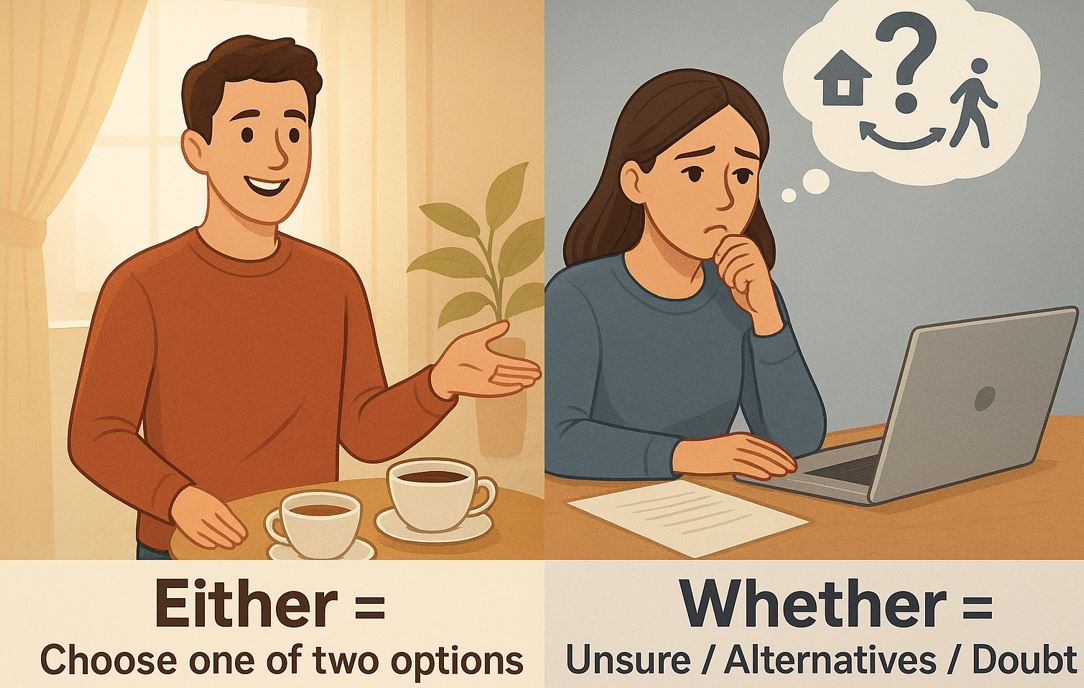
English learners often struggle with words that look similar but function differently in sentences. “Either” and “Whether” are two such words. They both appear in situations involving choices, but they are not interchangeable. Understanding the difference will help you write and speak more accurately, avoid confusion, and express choices clearly.
This guide will walk you through the meaning, definitions, correct uses, differences, examples, common mistakes, exercises, and even a small meme to help you remember the difference.
Meaning & Definitions
Either
Either is used to talk about one option or another.
It is often used:
- Before two choices
- To show one of the two
- To mean “any one of the two is fine”
Example:
You can choose either tea or coffee.
Whether
Whether is used to express uncertainty, doubt, or alternative possibilities within a sentence.
It commonly shows:
- If something is true or not
- Two or more possibilities
- A situation requiring a decision
Example:
I don’t know whether he will join the meeting.
Key Difference (Simple Explanation)
| Word | Used For | Simple Meaning | Example |
| Either | Choosing between two options | One or the other | Either you apologize, or you leave. |
| Whether | Expressing doubt or alternatives | If / If or not | Tell me whether you want to go. |
A quick trick:
“Either” = making a choice
“Whether” = expressing uncertainty
Either VS Whether full comparison chart
| Point of Comparison | Either | Whether |
|---|---|---|
| Definition | Used to present two (or sometimes more) options or choices. | Used to express uncertainty, doubt, or multiple possibilities, especially in indirect questions. |
| Primary Function | Shows a choice between alternatives. | Introduces possibilities or conditions, often in yes/no situations. |
| Grammar Type | Determiner, pronoun, conjunction. | Conjunction. |
| Common Usage | Indicates that one of the two options is acceptable. | Indicates that it is unknown which option is true, or introduces two or more alternatives. |
| Structure | Often follows the pattern: Either… or… | Often follows the pattern: Whether… or… |
| Example 1 | You can choose either tea or coffee. | I don’t know whether he will come or not. |
| Example 2 | Either option works for me. | Tell me whether you agree. |
| Used in Questions? | Rarely used in forming questions. | Commonly used in indirect questions. |
| Used for Conditions? | Not typically used. | Often used to introduce conditions or alternatives. |
| Formality Level | Neutral and commonly used in daily speech. | Slightly more formal, used more in writing and professional contexts. |
| Can Replace “If”? | No. | Yes, in some contexts (especially indirect questions). |
| Emphasis on Choice? | Strong emphasis on selecting one option. | Focus is on uncertainty, not choice. |
Detailed Examples
Using “Either”
- You can take either road to reach the beach.
- Either my phone is dead, or the network is down.
- You may sit on either side of the table.
Using “Whether”
- She can’t decide whether to study or relax.
- I wonder whether it’s going to rain today.
- Please tell me whether you agree.
Common Mistakes
Mistake 1: Using either instead of whether
I don’t know either he will come.
I don’t know whether he will come.
Mistake 2: Using “whether” for choosing directly
Choose whether tea or coffee.
Choose either tea or coffee.
Mistake 3: Adding “or not” unnecessarily
I’m not sure whether he is coming.
I’m not sure whether or not he is coming.
(Both are correct depending on style.)
Special Grammar Tips
Tip 1: “Whether” can start clauses after certain verbs like:
- ask
- decide
- wonder
- know
- doubt
Example:
She asked whether I was ready.
Tip 2: “Either” often pairs with “or.”
Either you study, or you fail.
Tip 3: “Whether” can be used before infinitives (to + verb)
I’m not sure whether to laugh or cry.
Practice Exercises
A. Fill in the blanks (Either / Whether)
- I can’t decide ______ I should travel now or later.
- You can choose ______ blue or red.
- She doesn’t know ______ he likes her.
- Take ______ of the two seats.
- Let me know ______ you want pizza.
Answers:
- whether
- either
- whether
- either
- whether
B. Correct the sentences
- She asked either I was tired.
- I don’t know either he is angry or not.
- You can pick whether chocolate or vanilla.
Answers:
- She asked whether I was tired.
- I don’t know whether he is angry or not.
- You can pick either chocolate or vanilla.
Easy Meme to Remember
Either = Choose between two things.
Whether = Not sure about something.
Brain:
“Choose either A or B.”
“I don’t know whether I want A or B.”
Quick Summary
- Either → used when making a choice between two options.
- Whether → used to show doubt, uncertainty, or alternatives.
- They cannot replace each other.
- “Either” usually comes with or.
- “Whether” often relates to a question, or unknown situation.
Frequently Asked Questions (FAQs): Either vs Whether
What is the simplest way to remember the difference between “either” and “whether”?
The easiest trick is: “Either” = choosing between two things, while “Whether” = expressing uncertainty or possibilities. If you are unsure about something, use whether. If you are selecting one of two, use either.
Can I use “either” and “whether” interchangeably?
| Point of Comparison | Either | Whether |
|---|---|---|
| Definition | Used to present two (or sometimes more) options or choices. | Used to express uncertainty, doubt, or multiple possibilities, especially in indirect questions. |
| Primary Function | Shows a choice between alternatives. | Introduces possibilities or conditions, often in yes/no situations. |
| Grammar Type | Determiner, pronoun, conjunction. | Conjunction. |
| Common Usage | Indicates that one of the two options is acceptable. | Indicates that it is unknown which option is true, or introduces two or more alternatives. |
| Structure | Often follows the pattern: Either… or… | Often follows the pattern: Whether… or… |
| Example 1 | You can choose either tea or coffee. | I don’t know whether he will come or not. |
| Example 2 | Either option works for me. | Tell me whether you agree. |
| Used in Questions? | Rarely used in forming questions. | Commonly used in indirect questions. |
| Used for Conditions? | Not typically used. | Often used to introduce conditions or alternatives. |
| Formality Level | Neutral and commonly used in daily speech. | Slightly more formal, used more in writing and professional contexts. |
| Can Replace “If”? | No. | Yes, in some contexts (especially indirect questions). |
| Emphasis on Choice? | Strong emphasis on selecting one option. | Focus is on uncertainty, not choice. |
Does “either” always need the word “or”?
Most of the time, yes. “Either” commonly appears with or to link two options:
Either tea or coffee.
However, when the two options are already implied, “either” can appear alone:
You can sit on either side.
When should I use “whether or not”?
Use whether or not when you want to show that something will happen in every situation, no matter the outcome.
Example:
I’m going outside whether or not it rains.
Can “whether” be used in formal writing?
Yes. “Whether” is perfectly acceptable in both formal and informal writing. In fact, it is often preferred in academic and professional writing because it clearly shows alternatives or uncertainty.
Is “if” the same as “whether”?
Not always. “If” is used for conditions, while “whether” is used for choices or unknown possibilities.
- Use if: If it rains, we’ll stay home.
- Use whether: I can’t decide whether to stay home or go out.
Can I use “either” for more than two options?
No. Either is specifically used for two choices only.
For more than two options, use words like any or one of.
Is “whether” always followed by “or”?
Not always. “Or” is used when you want to clearly present alternatives:
I don’t know whether he is coming or staying.
But if the alternative is understood, you can drop it:
I don’t know whether he is coming.
Can “either” be used in negative sentences?
Yes, but it changes meaning.
In negative sentences, “either” means “also not”.
Example:
I don’t like tea.
I don’t like coffee either.
What is a common mistake learners make with these two words?
Many learners mistakenly use either in sentences where whether is required. For example:
I don’t know either he is coming.
I don’t know whether he is coming.
Conclusion
Mastering the difference between either and whether can make your English clearer and more confident. Remember: either is about choosing, while whether is about uncertainty. With continuous practice using the examples and exercises above, you’ll start recognizing which word fits naturally in every situation.