
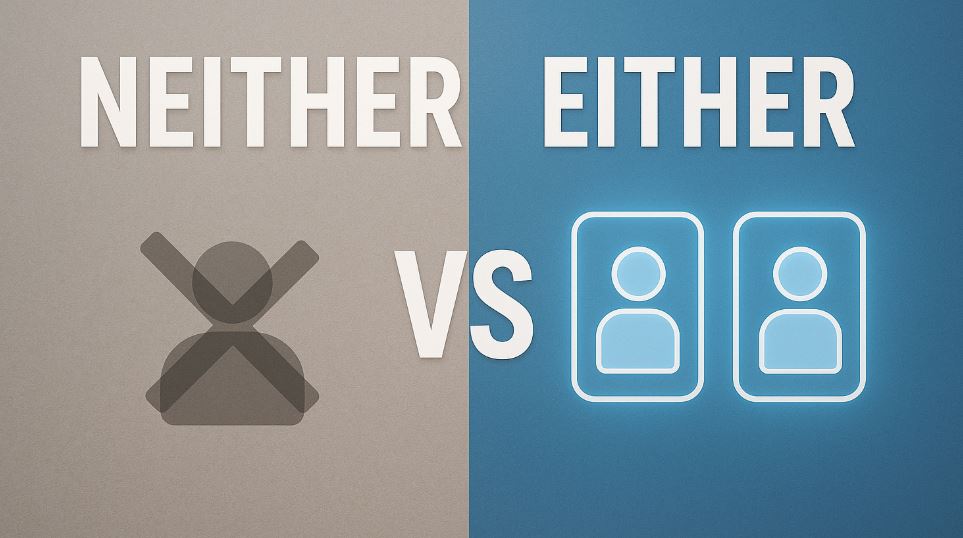
English learners often face challenges when encountering words that look or sound similar but have completely different meanings and uses. Two such commonly confusing words are “neither” and “either.” Although they might seem interchangeable at first, each serves a distinct purpose in English grammar. “Neither” is used to indicate that none of the two options is true or acceptable, expressing a negative choice.
On the other hand, “either” refers to one of the two options or can offer a choice, sometimes even appearing in negative sentences to mean “also not.” Understanding when and how to use these words correctly can make your writing and speaking much clearer and more natural.
We will explore their meanings, highlight the key differences, provide practical examples, include exercises for practice, and even share a fun, memorable meme to help you remember the distinction effortlessly.
Meaning of “Neither”
Neither is used to indicate not one nor the other of two things. It expresses a negative choice between two options.
Examples:
- Neither John nor Sarah attended the meeting.
- I like neither tea nor coffee.
- Neither of the books is interesting.
Tip: “Neither” is always used with two options or alternatives.
Meaning of “Either”
It expresses a positive choice between two options.
Examples:
- You can choose either chocolate or vanilla.
- Either of the roads will lead you to the park.
- I will either call you tonight or meet you tomorrow.
- I don’t like pizza, and I don’t like burgers either.
Key Differences Between Neither and Either
| Feature | Neither | Either |
| Meaning | Not one nor the other | One or the other |
| Type of sentence | Negative | Positive or choice-based |
| Usage | Used with two alternatives | Used with two alternatives or in negative contexts |
| Examples | Neither option is suitable. | You can pick either option. |
Quick Trick:
- Neither = NOT → use in negative sense.
- Either = ONE → use when offering a choice.
Exercises
Exercise 1: Fill in the blanks with “neither” or “either”.
- I don’t like pizza, and I don’t like pasta ______.
- ______ of the two dresses looks good on me.
- You can take ______ the red bag or the blue bag.
- ______ John nor Mary knows the answer.
- I haven’t seen the movie, and I haven’t read the book ______.
Answers:
- either
- Neither
- either
- Neither
- either
Exercise 2: Rewrite the sentences using “neither…nor” or “either…or”.
- I like coffee. I like tea. (negative)
- You can go to London. You can go to Paris. (choice)
Answers:
- I like neither coffee nor tea.
- You can go to either London or Paris.
Extra Tips
- Neither is often followed by singular verbs:
- Neither option is correct.
- Either can also refer to two people or things in conversation casually:
- Either of you can help me.
- Remember the subtle difference:
- Neither = reject both options
- Either = accept one of the options
Examples of Either and Neither
You’ll get the Either and Neither examples for improving your English skills. Here are 10 separate examples for Either and 10 separate examples for Neither
10 Examples of Either
(Used for choices, one or the other, affirmative meaning)
1. You can choose either tea or coffee for breakfast.
2. We can meet either at your office or at the café downtown.
3. Either dress looks great on you; pick the one you like more.
4. You can travel either by bus or by train from here.
5. Either solution will work, so let’s go with the faster one.
6. I’m fine with either day — Monday or Tuesday fits my schedule.
7. You may start the project either today or tomorrow morning.
8. Either room is available if you want to check in early.
9. You can pay either in cash or via digital payment.
10. Either option is okay, but one is definitely cheaper.
10 Examples of Neither
(Used for rejecting two options, negative meaning)
1. Neither answer is correct, so please try again.
2. Neither of the phones is fully charged right now.
3. Neither plan seems realistic given the tight deadline.
4. Neither of the restaurants is open on Sunday.
5. Neither student completed the assignment on time.
6. Neither movie appealed to me, so I stopped watching.
7. Neither explanation helped clear the confusion.
8. Neither proposal was accepted by the board.
9. Neither of my parents can attend the meeting today.
10. Neither laptop is working; both need repairs.
Read also: How to become a great English Teacher?
FAQs ( Either vs Neither )
Can “either” be used in negative sentences?
Yes! “Either” can mean “also not” in negative sentences: I don’t like coffee either.
Can “neither” be used alone?
Yes! Neither is suitable is correct in context.
Are “either…or” and “neither…nor” always used with two options?
Yes, these constructions are specifically for two alternatives.
Conclusion
Understanding the difference between neither and either is essential for clear and accurate communication in English. Neither helps you express a negative choice between two options, while either allows you to indicate a choice or possibility.
By practicing these words in daily conversations, writing exercises, and real-life examples, you can use them naturally without hesitation. Reading sentences carefully and trying “neither…nor” or “either…or” constructions will build confidence.
Over time, recognizing which word fits a situation will become instinctive, making your English more precise, fluent, and easy to understand for others.