
Understanding the difference between ‘neither’ and ‘none’ is one of the most common challenges in English grammar. Many learners confuse these two words because both are used to describe situations with no choices or negative outcomes. However, their meanings, grammar rules, and usage are not the same.
By the end of this article, you’ll confidently know when to use neither and when to use none—without second-guessing.
What Does “Neither” Mean? (Definition & Usage)
Definition of Neither
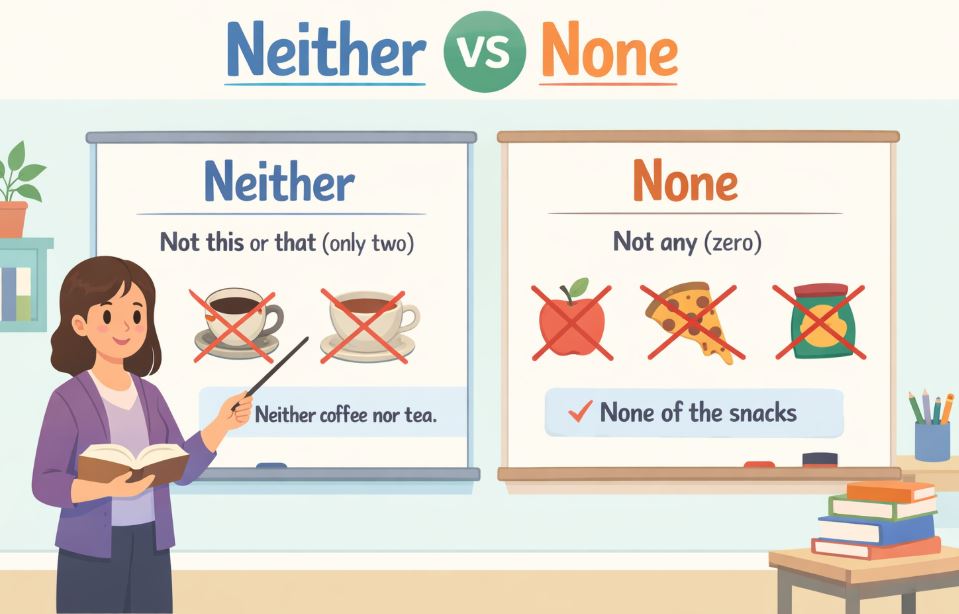
Neither means “not one nor the other” when talking about two choices only.
Think of neither as a word used for exactly two options.
Example:
I offered tea and coffee, but neither was accepted.
How “Neither” Is Used in Grammar
Neither can work in three ways:
1. As a Determiner
Used before a singular noun.
Neither answer is correct.
Neither student passed the test.
2. As a Pronoun
Used alone without a noun.
Which shirt do you like?
→ Neither.
3. As an Adverb (with “nor”)
Used to agree with a negative statement.
I don’t like horror movies.
→ Neither do I.
Sentence Structure with Neither
Neither + singular noun
Neither of + plural noun/pronoun
Verb is usually singular
Example:
Neither of the players is injured.
Neither Examples (Simple to Advanced)
Simple Examples:
Neither option seems good.
Neither answer is right.
Intermediate Examples:
Neither of my parents knows about the surprise.
Neither road leads to the village.
Advanced Examples:
Neither of the solutions provided by the committee appears effective.
What Does “None” Mean? (Definition & Usage)
Definition of None
None means “not any” or “zero amount.”
It can refer to two, many, or all items.
Unlike neither, none is not limited to two.
Example:
I checked all the files, but none were saved.
How “None” Is Used in Grammar
As a Pronoun
None of the money was stolen.
None of them are ready.
As a Determiner
None students attended the class. ❌
(Incorrect – “none” is rarely used this way today)
Singular vs Plural Verb with None
This is where learners struggle most.
Singular when referring to an uncountable noun:
None of the water is clean.
Plural when referring to countable nouns:
None of the books are missing.
In correct.
None of the food was eaten.
None of my friends agreed with me.
Neither vs None: Key Differences Explained Clearly
Core Difference in Meaning
| Feature | Neither | None |
|---|---|---|
| Number involved | Only two | Two or more |
| Meaning | Not this and not that | Not any |
| Verb agreement | Singular | Singular or plural |
When NOT to Use Neither
When talking about more than two items
❌ Neither of the five students came.
✅ None of the five students came.
When NOT to Use None
When referring to exactly two specific choices
❌ None of the two options works.
✅ Neither of the two options works.
Neither vs None in Real-Life Contexts
In Spoken English
Native speakers often use none casually.
“Neither” sounds slightly more formal.
In Academic & Formal Writing
Neither is preferred for logical comparisons.
None is common for statistics and data.
Neither vs None in Negative Sentences
Avoid double negatives.
❌ I don’t want none.
✅ I want none.
✅ I don’t want any.
Common Mistakes Learners Make (And Fixes)
Wrong: Using neither for more than two
Correct: Use none
❌ Wrong verb agreement
✔ Match the verb with meaning, not fear
❌ Confusing neither with either
✔ Either = positive, Neither = negative
Exercise and Uses of the Neither vs None
1. Exercise: Fill in the Blanks
______ of the answers is correct.
______ of my friends are available.
______ road leads to the airport.
2. Exercise: Choose the Correct Word
(Neither / None) of the two plans worked.
(Neither / None) of the information was useful.
3. Exercise: Sentence Correction
Correct the sentence:
None of the two solutions are acceptable.
Correct Answer:
→ Neither of the two solutions is acceptable.
Quick Rules Summary (One-Glance Guide)
Use neither for two choices
Use none for two or more
Neither = usually singular
None = singular or plural (both acceptable)
Read also more related topics: Neither VS Either
FAQs: Neither vs None
What is the difference between neither and none?
Neither refers to two items only, while none can refer to two or more items.
Can “none” be singular or plural?
Yes. Both are correct depending on meaning.
Is “neither” always singular?
Yes, in standard grammar, neither takes a singular verb.
Can I use “none” for two things?
Yes, but neither is usually clearer and more correct.
Which is more formal: neither or none?
Neither is slightly more formal, especially in writing.
Conclusion: Neither vs None Made Simple
To master neither vs none, remember this:
Neither = two choices only
None = zero amount, two or more
Match verbs carefully
Avoid double negatives
Practice using examples and exercises, and these confusing words will soon feel natural.