
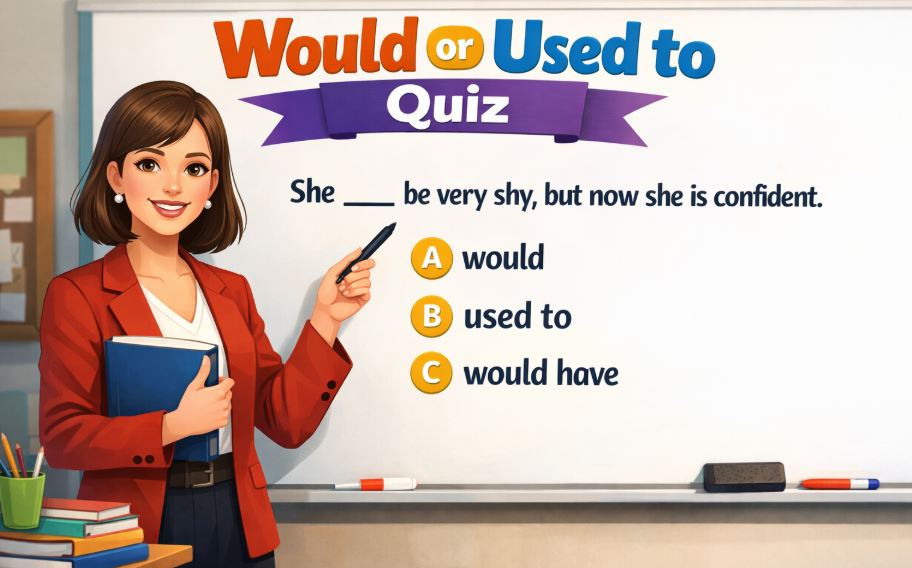
Understanding the difference between “would” and “used to” is essential for mastering English grammar, especially when talking about past habits and repeated actions. Many English learners get confused about when to use ‘would’ and when ‘used to’ is the better choice.
This would or used to a Quiz is designed to help you practice, test your understanding, and build confidence. Below, you’ll find a simple explanation, 10 multiple-choice questions (MCQs), and clear answers at the end to make learning easy and effective.
Would or Used to Quiz
Practice also more related quizzes: Anybody or Nobody Quiz
Do Somebody or Does Somebody Quiz
When to Use “Would” and “Used to”
Used to
- Describes past habits or states that no longer happen.
- It can be used for actions and situations.
Example:
I used to live in Dhaka.
Would
- Describes repeated past actions only (not states).
- Often used in storytelling or when the time reference is clear.
Example:
Every evening, my grandfather would tell us stories.
Would or Used to Quiz (MCQs)
1. When I was a child, I ___ play cricket in the street every day.
A) would
B) used to
C) both are correct
2. She ___ be very shy, but now she is confident.
A) would
B) used to
C) would have
3. During summer vacations, we ___ visit our grandparents in the village.
A) would
B) used to
C) would be
4. He ___ own a small bookstore before moving abroad.
A) would
B) used to
C) would own
5. Every night, my mother ___ read bedtime stories to me.
A) would
B) used to
C) would have
6. They ___ believe the earth was flat in ancient times.
A) would
B) used to
C) would believe
7. When we lived near the beach, we ___ watch the sunset together.
A) would
B) used to
C) would watch
8. I ___ hate vegetables, but now I enjoy them.
A) would
B) used to
C) would hate
9. On Sundays, my father ___ take us to the park.
A) would
B) used to
C) would take
10. She ___ have long hair when she was in college.
A) would
B) used to
C) would have
Quiz Answers
- C) both are correct
- B) used to
- C) both are correct
- B) used to
- A) would
- B) used to
- C) both are correct
- B) used to
- C) both are correct
- B) used to
Common Mistakes to Avoid
- Using would for past states
Incorrect: I would be shy as a child. - Use used to for past states
Correct: I used to be shy as a child.
Conclusion
The Would or Used to Quiz helps you clearly understand how these two grammar forms work in real sentences. Remember, “used to” works for both past habits and past states, while “would” is limited to repeated past actions. Practicing quizzes like this regularly will strengthen your grammar skills and improve your spoken and written English.
Keep practicing, and soon choosing between ‘would’ and ‘used to’ will feel natural!
FAQs: Would or Used to Quiz
Can “would” and “used to” be used interchangeably?
Yes, but only for repeated past actions, not for past states.
Why can’t “would” describe past states?
Because “would” focuses on actions, not conditions or situations.
Is “used to” still correct in modern English?
Absolutely. It is commonly used in both spoken and written English.
Are quizzes helpful for learning English grammar?
Yes. Quizzes improve retention and help learners identify weak areas.
Who should practice a Would or Used to Quiz?
English learners, students, teachers, and anyone preparing for exams like IELTS, SSC, or HSC.