
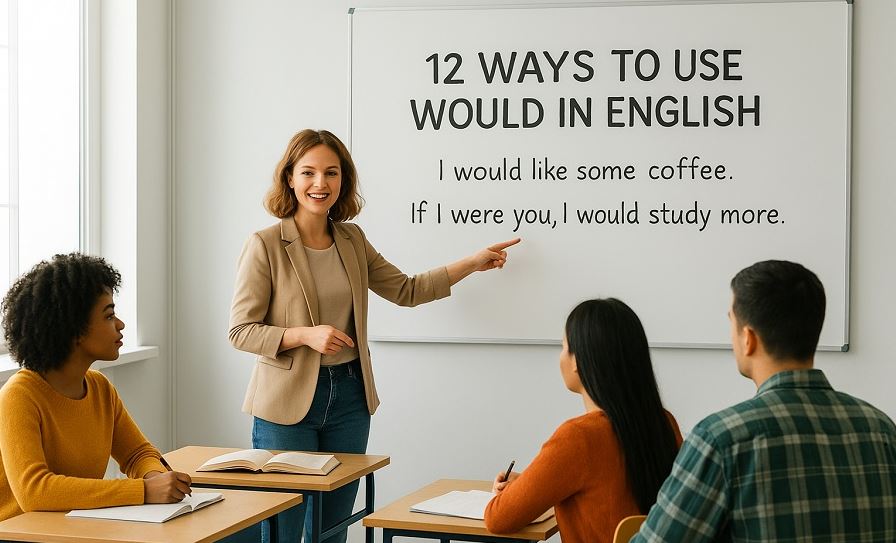
Learning how to use “would” is an important step in mastering English communication. This small but powerful word appears in many situations — from polite requests to imaginary conversations about the past or future. Understanding its uses helps you sound more natural, respectful, and fluent in everyday speech. For example, we say “I would like a cup of tea” to be polite or “If I won the lottery, I would travel the world” to describe a dream situation. We’ll explore 12 practical ways to use “would” with clear explanations and examples.
Whether you’re a beginner or an intermediate learner, this lesson will make it easier to understand how “would” changes meaning depending on the context. By the end, you’ll be confident using “would” in conversation, writing, and formal situations — just like a native speaker!
How to Use “Would” Correctly in English Sentences
The word “would” is one of the most commonly used modal verbs in English, but it can be tricky for learners because it serves many different purposes. Understanding how to use “would” correctly helps you sound more natural, polite, and fluent in both spoken and written English.
We mainly use “would” in the following situations:
- To express polite requests or offers:
- Would you like some coffee?
- I would love to help you.
- To talk about imaginary or unreal situations:
- If I were rich, I would travel the world.
- To describe past habits or repeated actions:
- When I was a child, I would play outside every day.
- To express preferences:
- I would rather stay home than go out tonight.
- To show future-in-the-past:
- He said he would call me later.
Practical Examples of How to Use “Would” in English
The modal verb “would” is one of the most versatile and commonly used words in English grammar. It helps express politeness, preferences, unreal situations, and even past habits.
Understanding how to use “would” in real-life situations makes your speech and writing more natural and fluent. Let’s look at some practical examples of how “would” is used in everyday English.
1. Polite Requests and Offers
Would you like some tea?
Would you mind helping me with this project?
Using “would” makes questions sound softer and more polite.
2. Talking About Hypothetical Situations
If I had a million dollars, I would travel the world.
She would help you if she knew the answer.
Here, “would” expresses imaginary or unreal conditions.
3. Expressing Preferences
I would rather stay home tonight.
He would prefer coffee instead of tea.
4. Describing Past Habits
When we were kids, we would play outside for hours.
This shows repeated actions in the past, similar to “used to.”
5. Showing Intentions or Willingness
I said I would call you later.
He promised he would help with the homework.
If you want to improve your skills about Would then try to give the would quiz test.
Complete Guide to Using “Would” in English
The word “would” is one of the most versatile and commonly used modal verbs in English. It helps express politeness, preferences, imaginary situations, past habits, and future actions in the past. Understanding how to use “would” correctly can make your English sound more natural and fluent.
Let’s explore the main ways “would” is used in everyday communication:
1. To express polite requests or offers:
Would you like some tea?
Would you help me with this task?
Here, “would” makes a request or offer sound more polite and formal.
2. To talk about hypothetical or unreal situations:
If I were rich, I would travel the world.
She would buy a new car if she had enough money.
“Would” is often paired with “if” to describe imaginary or conditional situations.
3. To describe past habits or repeated actions:
When we were kids, we would play outside every evening.
This use is similar to “used to” and describes something that happened regularly in the past.
4. To express preferences or desires:
I would rather stay home tonight.
I would like to visit Paris someday.
This form shows what someone wants or prefers in a polite way.
5. To talk about future in the past:
He said he would call me later.
In reported speech, “would” often replaces “will” to indicate a future action from a past point of view.
Step-by-Step Explanation of 12 ways to use would in English
The modal verb “would” is one of the most flexible and useful words in English. It helps us talk about the past, express politeness, show willingness, or describe imaginary situations.
To master English fluency, understanding the different uses of “would” is essential. Below is a step-by-step explanation of the 12 main uses of “would,” complete with clarity and practical meaning.
1. To Express Polite Requests
We often use would to make polite requests.
Example: “Would you help me with this report?”
It sounds more courteous than saying “Will you help me?”
2. To Offer Something Politely
Would softens offers and makes them sound friendly.
Example: “Would you like some tea?”
This is more polite than “Do you want some tea?”
3. To Express Preferences
You can use would rather or would prefer to express choices.
Example: “I would rather stay home than go out tonight.”
4. To Describe Imaginary or Unreal Situations
In conditional sentences, would talks about hypothetical situations.
Example: “If I were rich, I would travel the world.”
5. To Talk About Future in the Past
When reporting speech or thinking about the future from a past point of view, we use would.
Example: “He said he would call me later.”
6. To Describe Past Habits or Repeated Actions
Just like “used to,” would can describe actions that happened regularly in the past.
Example: “Every summer, we would visit our grandparents.”
7. To Show Willingness or Refusal in the Past
Would can express someone’s willingness—or lack of it.
Example: “She would always help anyone in need.”
Example: “He wouldn’t listen to anyone.”
8. To Express Polite Invitations
It’s also used to invite people in a gentle way.
Example: “Would you come to my birthday party?”
9. To Express Desire or Wish
Sometimes, would expresses something you want to happen.
Example: “I wish he would stop talking so loudly.”
10. To Give Advice Politely
Using would can make suggestions sound more polite or thoughtful.
Example: “I would recommend visiting that museum.”
11. To Make Assumptions or Guesses
We use would to make educated guesses about what might be true.
Example: “That would be John at the door.”
12. To Create a Polite Tone in Conversation
In general, would softens your speech, making it sound less direct or demanding.
Example: “I would appreciate it if you could send me the details.”
Difference Between Will and Would with Examples
Understanding the difference between “will” and “would” is essential for mastering English grammar. Both are modal verbs that express future actions, willingness, requests, and possibilities—but they are used in different contexts depending on time, condition, and politeness.
1. Basic Meaning
- Will is used for definite or certain future actions.
- Would is used for imagined, polite, or uncertain situations.
Examples:
- I will call you tomorrow. (definite future)
- I would call you if I had your number. (imaginary situation)
2. Tense Relationship
- Will is used in the present or future tense.
- Would is the past form of will and is often used in reported speech or conditional sentences.
Examples:
- He says he will help us.
- He said he would help us.
3. Politeness
“Would” is softer and more polite than “will.”
Examples:
- Will you help me? (direct)
- Would you help me, please? (polite and formal)
4. Hypothetical Situations
Use would for unreal or imaginary actions.
Examples:
- If I were rich, I would travel the world.
- She would buy a car if she had enough money.
5. Promises and Predictions
Use will for decisions, promises, and predictions.
How to Use “Would” in Conditional Sentences
The word “would” plays a key role in conditional sentences, helping us talk about imaginary, unreal, or possible situations. It’s mainly used in second and third conditional sentences to express what could happen under certain conditions.
1. In Second Conditionals (Unreal Present or Future)
We use “would” + base verb in the main clause and “if” + past simple in the if-clause. This structure shows imaginary or unlikely situations in the present or future.
Structure:
If + past simple, would + base verb
Examples:
- If I had a car, I would drive to work.
- She would travel the world if she won the lottery.
Here, the speaker imagines a situation that isn’t real right now.
2. In Third Conditionals (Unreal Past)
We use “would have” + past participle in the main clause and “if” + past perfect in the if-clause. This expresses imaginary situations in the past — things that didn’t actually happen.
Structure:
If + past perfect, would have + past participle
Examples:
- If he had studied, he would have passed the exam.
- They would have come if they had known about the party.
These sentences talk about regret or missed opportunities.
3. Key Tips
- Use “would” for the result part of the conditional.
- Don’t use “would” in the if-clause — that’s a common mistake.
- Remember: “Would” shows possibility, imagination, or politeness depending on context.
1. Using “Would” in Both Parts of a Conditional Sentence
If I would have time, I would visit you.
If I had time, I would visit you.
Tip: In conditional sentences, use “would” only in the main clause, not in the if-clause.
2. Mixing “Will” and “Would” Incorrectly
I will go if it would stop raining.
I will go if it stops raining.
Tip: Use “will” for real possibilities and “would” for imagined or unreal situations.
3. Forgetting to Use the Base Form After “Would”
I would to go there someday.
I would go there someday.
Tip: After “would,” always use the base form of the verb (go, eat, study), not to + verb.
4. Confusing “Would” and “Used to” for Past Habits
I would live in Dhaka when I was a child. (incorrect if describing a past fact)
I used to live in Dhaka when I was a child.
Tip: Use “would” only for repeated past actions, not for past states or facts.
5. Using “Would” Instead of “Will” for Future Plans
I would call you tomorrow.
I will call you tomorrow.
Tip: Use “will” for definite future actions; “would” expresses a hypothetical or polite tone.
Conclusion
Mastering the 12 ways to use “would” in English opens the door to more natural, fluent, and confident communication. Whether you’re describing polite requests, expressing desires, making offers, or imagining hypothetical situations, would adds depth and subtlety to your speech.
It helps you sound more courteous, thoughtful, and precise — key qualities of advanced English speakers. The more you practice using would in real-life contexts, the easier it becomes to express your thoughts smoothly and accurately. So, keep experimenting with this versatile modal verb, and soon you’ll find yourself using would effortlessly in every kind of conversation.