
Preparing for exams in a short time can feel stressful. Many students face this situation. The good news is that it is possible to succeed—even with just one week.
The key is not to study harder, but to study smarter. With the right plan, clear focus, and simple learning techniques, you can use your time effectively. This guide will show you how to prepare for exams in one week with easy steps you can follow at home.
Is One Week Enough to Study for an Exam?
Yes, one week can be enough—but only if you use it wisely.
You are more likely to succeed if:
- You already know some basics
- You focus on important topics
- You use active study methods
Some factors also affect your results:
- Subject difficulty: Hard subjects need more practice
- Your current level: Beginners may need extra time
- Study method: Smart study beats long hours
Instead of worrying, focus on what matters most.
How to Study for Exams in 7 Days at Home (Step-by-Step Plan)
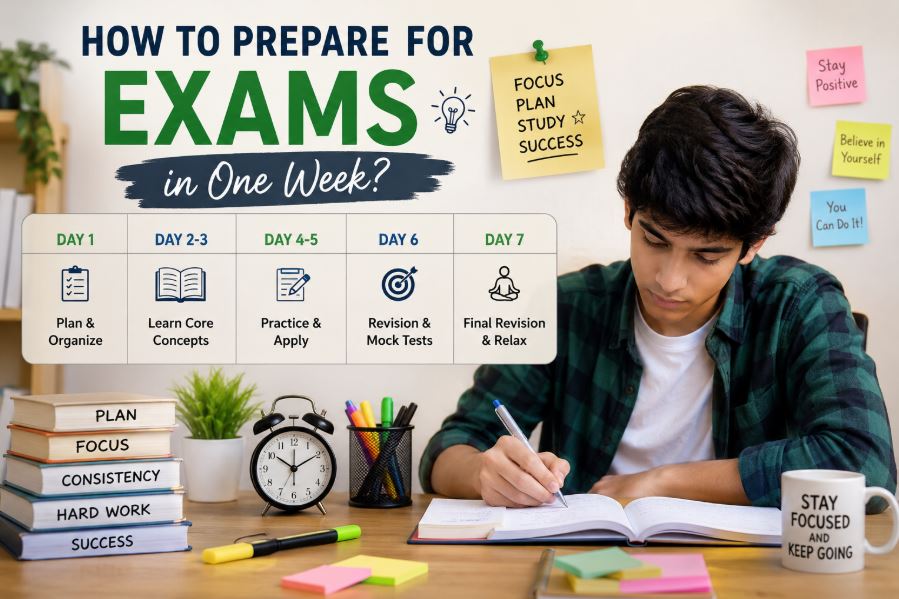
A clear plan helps you stay organized and confident. Here is a simple 7-day strategy:
Day 1: Plan and Organize
Start with a clear overview.
- Check your syllabus
- List important topics
- Create a simple study schedule
Tip: Keep your plan realistic and easy to follow.
Day 2–3: Learn Core Concepts
Focus on understanding the basics.
- Study key chapters
- Write short notes
- Explain topics in your own words
Goal: Build a strong foundation.
Day 4–5: Practice and Apply
Now, test what you learned.
- Solve past exam papers
- Practice important questions
- Work on weak areas
Tip: Practice helps you remember better.
Day 6: Revision and Mock Tests
Prepare for the real exam.
- Take a full mock test
- Check your mistakes
- Revise key points
Focus: Improve speed and accuracy.
Day 7: Final Revision and Rest
Keep things light and simple.
- Review notes
- Avoid new topics
- Stay calm and relaxed
Remember: A fresh mind performs better.
Simple Tips for Exam Preparation
Use these easy tips to improve your results:
- Study in short sessions (25–30 minutes)
- Take regular breaks
- Keep your study space clean and quiet
- Focus on important topics first
- Drink water and eat healthy food
- Get enough sleep every night
How to Prepare for Semester Exams in a Week?
Semester exams cover more topics. So, you need a smart approach.
What to Focus On:
- Important theories
- Key concepts
- Repeated questions from past exams
Study Method:
- Use short notes for quick revision
- Choose group study for discussion
- Study alone for deep focus
Pick what works best for you.
Best Study Techniques for Last-Minute Preparation
These methods save time and improve learning:
- Active Recall: Test yourself often
- Spaced Revision: Review topics again and again
- Mind Maps: Use diagrams to understand ideas
- Flashcards: Great for quick memory
- Practice Tests: Build confidence
Common Mistakes to Avoid
Avoid these common problems:
- Studying without understanding
- Ignoring difficult subjects
- Sleeping too little
- Using too many books or resources
Keep your study plan simple and focused.
Sample 7-Day Study Routine
Here is a simple daily routine:
- Morning: Learn new topics
- Afternoon: Practice questions
- Evening: Revise topics
- Night: Quick review
Adjust this routine based on your energy level.
Motivation and Stress Management Tips
Staying calm is very important.
- Set small daily goals
- Take short breaks
- Practice deep breathing
- Stay positive
Confidence helps you perform better.
How to motivate my son to study?
Motivating a child to study isn’t about pressure—it’s about building interest, confidence, and a positive routine. If you’re wondering how to motivate your son to study, the goal is to guide him in a way that feels supportive, not forced.
Here’s a practical, effective approach:
1. Understand the Root Cause
Before pushing him to study, find out why he is not motivated.
- Is he bored with the subject?
- Does he feel overwhelmed or confused?
- Is he distracted by games or social media?
Talk calmly and listen without judgment. This builds trust and helps you respond in the right way.
2. Set Clear and Achievable Goals
Large tasks can feel scary. Break study time into small, simple goals.
- “Finish one chapter” instead of “study everything”
- “Study for 30 minutes” instead of “study all evening”
Small wins build confidence and motivation.
3. Create a Consistent Study Routine
Children respond well to structure.
- Set a fixed time for study every day
- Keep the environment quiet and distraction-free
- Include short breaks to avoid burnout
A routine turns studying into a habit.
4. Make Learning Interesting
If studying feels boring, motivation drops quickly.
- Use videos, diagrams, or real-life examples
- Turn lessons into quizzes or games
- Encourage curiosity instead of memorization
When learning becomes engaging, effort follows naturally.
5. Encourage, Don’t Pressure
Constant pressure can reduce motivation.
- Praise effort, not just results
- Avoid comparing him to others
- Stay positive, even when he struggles
A supportive environment builds long-term confidence.
6. Limit Distractions
Too much screen time can affect focus.
- Set clear rules for mobile or gaming time
- Keep study time device-free if possible
- Use apps or timers to manage screen use
Balance is key—not complete restriction.
7. Be a Role Model
Children often copy what they see.
- Show discipline in your own routine
- Read, learn, or work in front of him
- Share your own learning experiences
Your behavior can inspire more than words.
8. Reward Effort in a Healthy Way
Rewards can boost motivation when used wisely.
- Offer small rewards for completing tasks
- Give praise, extra playtime, or a favorite activity
- Avoid over-rewarding, which can reduce intrinsic motivation
9. Focus on Strengths and Interests
Every child is different.
- Support subjects he enjoys
- Connect difficult subjects to his interests
- Build confidence through his strengths
This creates a positive attitude toward learning.
10. Be Patient and Consistent
Motivation doesn’t change overnight.
- Stay calm and consistent
- Avoid sudden strict rules
- Keep encouraging progress, no matter how small
Read also more related topics: How to use AI tools for studying?
How to avoid distractions while studying?
FAQs
How many hours should I study daily in one week?
You can study 6–8 focused hours per day.
Can I pass an exam by studying for 7 days?
Yes, if you follow a clear plan and focus on key topics.
What is the fastest way to memorize?
Use active recall and repetition.
How can I stay focused at home?
Study in a quiet place and follow a fixed routine.
Conclusion
You can prepare for exams in one week if you use your time wisely. Focus on important topics, follow a simple plan, and stay consistent.
Remember, it is not about studying more—it is about studying smart. Stay calm, stay focused, and give your best effort.
1 thought on “How to Prepare for Exams in One Week (Simple 7-Day Study Plan)”