
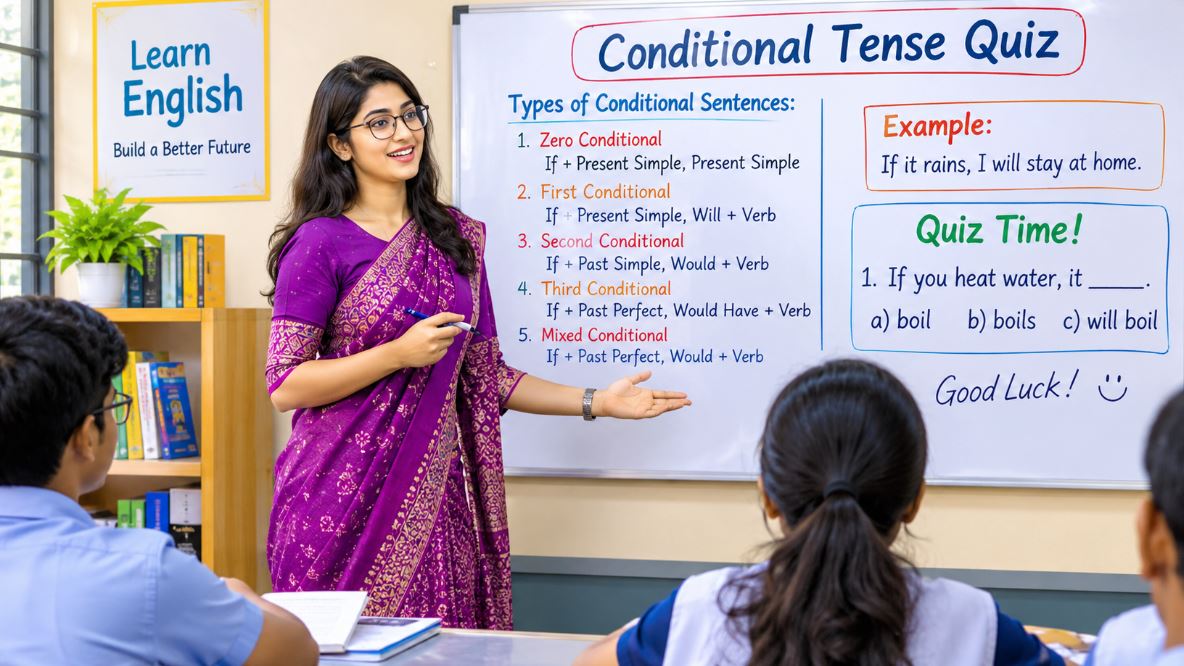
Do you want to improve your English grammar and become more confident when speaking and writing? Understanding conditional sentences is an important part of learning English. They help us talk about possibilities, imaginary situations, real-life conditions, and things that could have happened in the past.
Our Conditional Tense Quiz is designed to help you test your English Grammar knowledge through 10 interesting multiple-choice questions. Whether you are a beginner, an intermediate English learner, or someone preparing for an English proficiency examination, this quiz will help you understand how conditional sentences work.
In this Conditional Tense Quiz Test, you will find three answer options (a, b, and c) for each question. Complete all 10 questions before checking the answer key and explanations at the end. Let’s get started and see how well you understand conditional tenses!
What Is Conditional Tense in English Grammar?
Conditional tense refers to grammatical structures used to express situations that depend on certain conditions. These sentences usually explain what happens, what will happen, what might happen, or what could have happened if a particular condition is fulfilled.
A conditional sentence generally contains two parts:
If-clause: Describes the condition.
Main clause: Explains the result of that condition.
For example:
“If you study hard, you will pass the examination.”
In this sentence:
“If you study hard” is the condition.
“You will pass the examination” is the result.
Conditional sentences commonly use the word “if,” although other expressions, such as “unless,” “provided that,” and “as long as,” can also introduce conditions.
Learning conditional structures will help you communicate more naturally and express different situations accurately.
Types of Conditional Sentences in English
There are five commonly taught types of conditional sentences in English grammar. Each type has a different purpose and structure.
1. Zero Conditional
The zero conditional is used to describe general truths, scientific facts, habits, and situations that are always true when a particular condition occurs.
Structure:
If + Present Simple, Present Simple.
Examples:
If you heat ice, it melts.
If people don’t drink water, they become thirsty.
If you mix red and blue, you get purple.
When to use it: Use the zero conditional when describing facts, rules, and things that are generally true.
2. First Conditional
The first conditional describes real or possible situations that may happen in the future.
Structure:
If + Present Simple, Will + Base Verb.
Examples:
If it rains, I will stay at home.
If you study hard, you will pass the test.
If she arrives early, we will go shopping.
When to use it: Use the first conditional when talking about realistic future possibilities and their likely results.
3. Second Conditional
The second conditional is used to describe imaginary, unlikely, or hypothetical situations in the present or future.
Structure:
If + Past Simple, Would + Base Verb.
Examples:
If I were rich, I would travel around the world.
If I had more time, I would learn another language.
If she knew the answer, she would tell us.
When to use it: Use the second conditional when discussing unreal or unlikely situations.
Grammar tip: In formal English, “were” is commonly used with all subjects in hypothetical statements, especially in the expression “If I were you.”
4. Third Conditional
The third conditional describes imaginary situations in the past. It explains how things could have been different if something had happened differently.
Structure:
If + Past Perfect, Would Have + Past Participle.
Examples:
If I had studied harder, I would have passed the examination.
If she had left earlier, she would have caught the bus.
If they had invited me, I would have attended the party.
When to use it: Use the third conditional to discuss past regrets, missed opportunities, and alternative past results.
5. Mixed Conditional
Mixed conditionals combine different conditional structures to connect a past condition with a present result or a present condition with a past result.
Common structure (past condition and present result):
If + Past Perfect, Would + Base Verb.
Examples:
If I had studied medicine, I would be a doctor now.
If she had taken the job, she would live in London today.
If he had saved money, he would be financially comfortable now.
When to use it: Use mixed conditionals when the condition and result refer to different times.
Why Should You Practice a Conditional Tense Quiz Test?
Practicing a Conditional Tense Quiz Test is an effective way to improve your understanding of English grammar.
Here are some important benefits:
1. Improve Grammar Knowledge
Regular practice helps you understand the structures of zero, first, second, third, and mixed conditionals.
2. Develop Better Writing Skills
Conditional sentences make your writing more meaningful by helping you explain possibilities, consequences, and hypothetical situations.
3. Improve Everyday Communication
You can use conditional sentences in daily conversations to discuss plans, predictions, advice, and imaginary situations.
4. Prepare for English Examinations
Conditional grammar is useful for school examinations, English grammar tests, competitive examinations, and language proficiency preparation.
5. Identify Your Weaknesses
Multiple-choice questions help you recognize grammatical mistakes and understand which conditional structures require more practice.
Conditional Tenses quiz test
Common Rules for Using Conditional Tenses
Before attempting the quiz, review these important grammar rules.
| Conditional type | If-clause | Main clause |
|---|---|---|
| Zero | Present Simple | Present Simple |
| First | Present Simple | Will + Base Verb |
| Second | Past Simple | Would + Base Verb |
| Third | Past Perfect | Would Have + Past Participle |
| Mixed | Past Perfect | Would + Base Verb |
Important grammar rules:
Do not normally use “will” directly after “if” in standard first conditional sentences.
Use the past perfect in the if-clause of a standard third conditional.
Use “would” in the main clause of standard second conditional sentences.
Use “would have” with a past participle in standard third conditional sentences.
Remember that the if-clause and main clause can change positions without changing the basic meaning.
Now that you understand the rules, it’s time to test your knowledge!
Conditional Tense Quiz: 10 Multiple-Choice Questions
1. If you heat water to 100°C, it ____.
2. If it rains tomorrow, we ____ at home.
3. If I ____ a bird, I would fly around the world.
4. If she had studied harder, she ____ the examination.
5. If I had more money, I ____ a new laptop.
6. If you don’t water plants, they ____.
7. If he ____ earlier, he would have caught the train.
8. If I were you, I ____ apologize to the teacher.
9. If they invite me, I ____ to the party.
10. If she had taken the medicine, she ____ better now.
Conditional Tense Quiz Answers and Explanations
Here is the answer key for all 10 questions, along with brief explanations to help you understand the correct grammatical structures.
| Question | Correct answer | Conditional type |
|---|---|---|
| 1 | b) boils | Zero Conditional |
| 2 | c) will stay | First Conditional |
| 3 | b) were | Second Conditional |
| 4 | c) would have passed | Third Conditional |
| 5 | b) would buy | Second Conditional |
| 6 | a) die | Zero Conditional |
| 7 | b) had left | Third Conditional |
| 8 | b) would | Second Conditional |
| 9 | a) will go | First Conditional |
| 10 | c) would feel | Mixed Conditional |
Detailed Answer Explanations
Question 1: b) boils
The zero conditional describes a general scientific fact. Therefore, both clauses use the present simple tense.
Question 2: c) will stay
This sentence describes a possible future situation. The first conditional uses the present simple in the if-clause and “will” in the main clause.
Question 3: b) were
The sentence describes an imaginary situation. The second conditional uses “were” to express an unreal condition.
Question 4: c) would have passed
This sentence describes an unreal past situation. The third conditional uses “would have” followed by the past participle.
Question 5: b) would buy
The speaker is imagining having more money. This is a hypothetical present situation, so the second conditional is appropriate.
Question 6: a) die
This sentence expresses a general truth about plants. The zero conditional uses the present simple in both clauses.
Question 7: b) had left
The sentence describes a missed opportunity in the past. The third conditional requires the past perfect in the if-clause.
Question 8: b) would
The expression “If I were you” is commonly used to give hypothetical advice. The correct structure is “would + base verb.”
Question 9: a) will go
The sentence describes a realistic possibility in the future. Therefore, the first conditional is correct.
Question 10: c) would feel
This is a mixed conditional because the condition refers to the past, while the result refers to the present.
Common Mistakes to Avoid When Using Conditional Sentences
Even experienced English learners sometimes make mistakes when using conditional sentences. Understanding these common errors can help you improve your grammar.
1. Using Will After If
Incorrect: If it will rain, I will stay home.
Correct: If it rains, I will stay home.
Explanation: In standard first conditional sentences, use the present simple after “if.”
2. Confusing Second and Third Conditionals
Incorrect: If I had studied, I would pass the examination yesterday.
Correct: If I had studied, I would have passed the examination yesterday.
Explanation: Use the third conditional when imagining a different result in the past tense.
3. Using the Wrong Verb Form
Incorrect: If I were rich, I would bought a big house.
Correct: If I were rich, I would buy a big house.
Explanation: Use the base form of the verb after “would.”
4. Forgetting the Past Perfect
Incorrect: If she studied harder, she would have passed.
Correct: If she had studied harder, she would have passed.
Explanation: A standard third conditional sentence requires the past perfect in its if-clause.
5. Mixing Conditional Structures Incorrectly
Incorrect: If I had saved money, I will be rich now.
Correct: If I had saved money, I would be rich now.
Explanation: A past condition with a present result generally uses the mixed conditional structure.
Frequently Asked Questions (FAQs) About Conditional Tense
Here are some common questions that English learners ask about conditional sentences.
What is a conditional tense in English grammar?
Conditional tense refers to grammatical structures that express situations depending on particular conditions. These English structures help explain possibilities, imaginary situations, general truths, and alternative past events.
How many types of conditional sentences are there?
There are five commonly taught types of conditional sentences: zero conditional, first conditional, second conditional, third conditional, and mixed conditional. Each type expresses a different relationship between a condition and its result.
What is the difference between first and second conditional?
The first conditional describes realistic or possible future situations, while the second conditional describes imaginary, unlikely, or hypothetical situations.
Example of first conditional: If I study, I will pass.
Example of second conditional: If I were rich, I would travel.
When do we use the third conditional?
We use the third conditional to discuss imaginary situations in the past, including regrets and missed opportunities.
Example: If I had woken up earlier, I would have caught the bus.
What is the structure of the zero conditional?
The zero conditional follows this structure:
If + Present Simple, Present Simple.
Example: If you freeze water, it becomes ice.
It is commonly used for scientific facts and general truths.
Can we use unless instead of if?
Yes. “Unless” can replace “if…not” in many conditional sentences.
Example:
If you do not hurry, you will miss the bus.
Unless you hurry, you will miss the bus.
Both sentences express a similar meaning.
Why is practicing a Conditional Tense Quiz important?
Practicing a Conditional Tense Quiz helps learners understand sentence structures, improve grammatical accuracy, recognize common mistakes, and develop better English communication skills.
How can I improve my conditional sentence skills?
You can improve your conditional sentence skills by learning the five conditional structures, reading English examples, writing your own sentences, practicing multiple-choice grammar questions, and reviewing incorrect answers.
What is a mixed conditional sentence?
A mixed conditional combines two different time references. It often describes how an unreal past situation affects the present. Example: If I had studied harder, I would have a better job now.
Are conditional sentences important for English exams?
Yes. Conditional sentences are an important grammar topic in many English language examinations, school tests, and language-learning assessments. Understanding them can improve your performance in grammar, writing, and sentence-completion exercises.
Conclusion
Learning conditional sentences is essential for developing strong English grammar skills. They allow you to express facts, future possibilities, imaginary situations, past regrets, and different hypothetical circumstances. This Conditional Tense Quiz provides 10 multiple-choice questions to help you test your understanding of zero, first, second, third, and mixed conditional sentences. By completing the Conditional Quiz Test, you can identify your mistakes and improve your grammar knowledge.
Remember that consistent practice is the key to mastering English grammar. Keep learning the rules, create your own conditional sentences, and challenge yourself with more grammar exercises. How many questions did you answer correctly? Keep practicing, and you will become more confident in using conditional sentences in everyday English!