
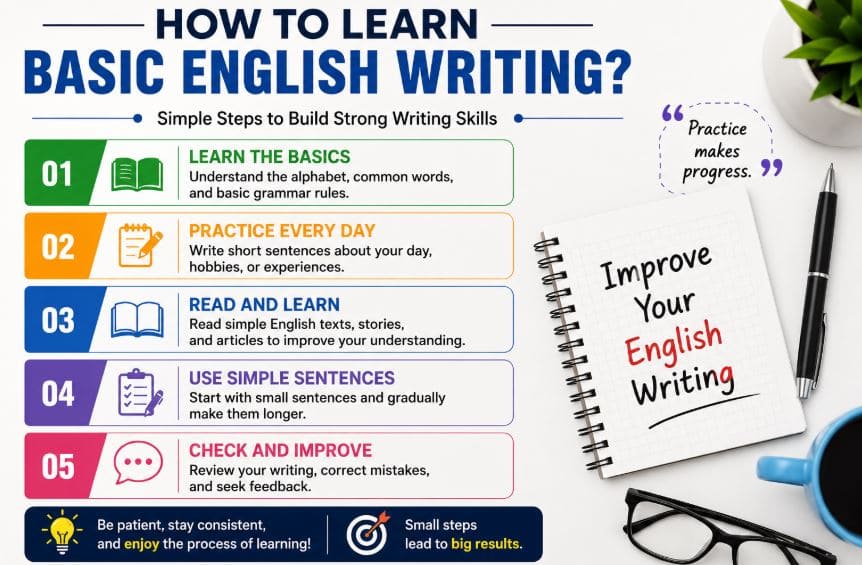
Learning basic English writing is one of the most useful skills you can develop. Whether you want to write emails, social media posts, school assignments, or simple stories, strong writing helps you express ideas clearly and confidently.
This guide shows you exactly how to learn basic English writing for beginners, what core skills you need, a practical 7-step process, how to teach yourself, and free online resources you can start using today.
Why Basic English Writing Skills Matter?
Basic English writing skills include forming correct sentences, using proper punctuation, organizing ideas, and choosing the right words.
These skills improve communication at work, school, and in daily life. When you write clearly, people understand you better and take you more seriously.
How to Learn Basic English Writing for Beginners?
Start simple and build consistency. Follow these practical steps:
- Master the building blocks
Learn the alphabet, basic vocabulary, simple sentence structure (Subject + Verb + Object), and common punctuation marks (period, comma, question mark, apostrophe). - Read every day
Reading short articles, children’s books, or simple blogs shows you how correct English looks and flows. Notice how sentences begin and end. - Write a little every day
Keep a daily journal. Write 5–10 simple sentences about your day, what you ate, or what you plan to do. Consistency beats long sessions. - Focus on one skill at a time
Spend a week on capital letters and periods. Next week focus on connecting words like “and,” “but,” and “because.” - Get feedback
Share your writing with a friend, teacher, or free online community and ask for corrections.
What Are the 7 Steps of Writing Skills?
These seven steps give beginners a clear path from idea to finished paragraph:
- Understand the purpose – Decide why you are writing (to inform, describe, or request something).
- Gather simple ideas – List the main points you want to say.
- Organize your thoughts – Put ideas in a logical order (beginning, middle, end).
- Write a first draft – Focus on getting ideas down without worrying about perfection.
- Check grammar and spelling – Fix basic mistakes in sentences, verbs, and punctuation.
- Improve word choice and clarity – Replace unclear words with simpler, stronger ones.
- Read aloud and revise – Reading your writing out loud helps you catch awkward sentences and improve flow.
Practice these steps with short paragraphs. Over time they become natural.
How Can I Teach Myself to Write?
Self-teaching works well if you stay disciplined. Here is a realistic plan:
- Set a daily goal of 15–20 minutes.
- Use free notebooks or phone notes to write.
- Copy short, correct sentences from books or websites, then rewrite them in your own words.
- Record yourself speaking about a topic, then write what you said.
- Track progress by saving early and later versions of your writing so you can see improvement.
- Join free online writing groups or language exchange apps where people correct each other’s work.
The key is regular practice plus honest review of your own mistakes.
Basic English Writing Skills You Should Practice
Focus on these core areas:
- Simple sentence structure
- Correct use of capital letters and end punctuation
- Common verb tenses (present, past, future)
- Basic connectors (and, but, so, because, then)
- Clear paragraph organization (one main idea per paragraph)
- Everyday vocabulary for describing people, places, actions, and feelings
Mastering these gives you a strong foundation before moving to advanced writing.
How to Learn Basic English Writing for Beginners Online for Free
You do not need expensive courses. Excellent free resources exist:
- British Council LearnEnglish and BBC Learning English – free lessons, writing exercises, and grammar practice.
- Duolingo and Busuu – short daily writing and grammar activities.
- YouTube channels – search for “basic English writing for beginners” for free video lessons.
- Grammarly (free version) or LanguageTool – instant feedback on spelling and basic grammar.
- Free writing prompts on sites like WriteAbout or simple Reddit communities (r/WriteStreakEN).
- Google Docs or any notes app – write daily and use the built-in spell checker.
Combine one free website with daily journaling for the best results.
Practical Tips to Improve Faster
- Write about topics you enjoy (food, hobbies, daily routines).
- Keep sentences short at first (8–12 words).
- Read your writing the next day with fresh eyes.
- Celebrate small wins – finishing a short paragraph is progress.
- Review common mistakes weekly so they do not become habits.
Explore Advanced Grammar Rules: Take Your English Writing to the Next Level
Once you feel comfortable with basic English writing—simple sentences, everyday vocabulary, and correct punctuation—it is time to explore advanced grammar rules.
These rules help you write with more precision, variety, and sophistication. They allow you to express complex ideas clearly, sound more natural, and impress readers in academic, professional, or creative contexts.
Advanced grammar is not about memorizing endless lists. It is about understanding how English works at a deeper level so your writing becomes flexible and powerful.
Why Advanced Grammar Matters
Basic grammar gets your message across. Advanced grammar makes it elegant, accurate, and engaging. It helps you:
- Avoid common errors that make writing sound amateur
- Create longer, more interesting sentences without confusion
- Express subtle meanings, hypothetical situations, and relationships between ideas
- Write confidently for exams, job applications, reports, or storytelling
Key Advanced Grammar Rules to Master
Here are the most useful advanced areas for intermediate and advanced learners.
1. Complex Sentence Structures
Move beyond simple Subject + Verb + Object sentences. Learn to combine ideas using:
- Subordinating conjunctions: although, because, while, since, even though, unless
- Relative clauses: who, which, that, whose, where, when
- Participial phrases: Walking down the street, she noticed the open café.
Example
Basic: She finished her work. She went home.
Advanced: Having finished her work, she went home. / Although she was tired, she finished her work before going home.
2. Conditionals (Especially Mixed and Advanced Forms)
You already know zero, first, second, and third conditionals. Advanced writing often uses mixed conditionals and inverted forms.
- Mixed: If I had studied harder (past), I would have a better job now (present).
- Inverted: Had I known about the meeting, I would have attended. (Instead of “If I had known…”)
These forms sound more formal and natural in sophisticated writing.
3. Passive Voice (When and How to Use It Well)
The passive voice is not just “be + past participle.” Advanced writers use it strategically:
- To emphasize the action or result rather than the doer
- In formal or scientific writing
- With modal verbs: The report should have been submitted yesterday.
- Causative structures: I had my car repaired. / She got her hair cut.
Overusing the passive makes writing weak. Use it only when it serves a clear purpose.
4. Reported (Indirect) Speech with Advanced Nuances
Go beyond basic tense shifts. Master:
- Reporting verbs that change meaning: claim, insist, suggest, recommend, deny, admit
- Changes in time and place expressions
- Reporting questions and commands accurately
- Backshifting in complex situations
Example
Direct: “I will finish it tomorrow,” she said.
Reported: She said she would finish it the following day. / She promised to finish it the next day.
5. The Subjunctive Mood
The subjunctive is less common in everyday speech but still important in formal writing:
- After verbs like suggest, recommend, insist, demand: I suggest that he be present.
- In fixed expressions: If I were you… / God save the Queen.
- In “that” clauses expressing necessity or importance.
6. Advanced Verb Forms and Aspect
Understand the differences between:
- Present perfect continuous vs. present perfect
- Past perfect continuous
- Future perfect and future perfect continuous
- Stative vs. dynamic uses of verbs
These help you show exact timing and duration of actions.
7. Nominalization and Formal Style
Turn verbs and adjectives into nouns to create a more academic tone:
- “The team decided” → “The team’s decision”
- “People are concerned” → “There is growing concern”
Use this carefully so your writing does not become heavy or unnatural.
Practical Ways to Practice Advanced Grammar
- Read high-quality material daily (BBC, The Guardian, well-written novels, academic articles). Notice how writers use complex structures.
- Rewrite simple paragraphs using advanced forms.
- Keep an error log. When you make a mistake with conditionals or relative clauses, write the correct version and an explanation.
- Use free tools like Grammarly (premium features help), Language Tool, or Cambridge Dictionary examples.
- Write short essays or journal entries focusing on one advanced rule per week.
- Get feedback from advanced speakers or writing communities.
Common Pitfalls to Avoid
- Forcing complex sentences when simple ones are clearer
- Mixing tenses incorrectly in conditionals
- Overusing the passive voice
- Creating run-on sentences or comma splices while trying to sound advanced
- Ignoring subject-verb agreement in long, complex sentences
Clarity always comes first. Advanced grammar should make your meaning sharper, not more confusing.
Start Today and Stay Consistent
Learning how to learn basic English writing is not about perfection on day one. It is about steady practice. Begin with simple sentences, follow the 7 steps, use free online tools, and write a little every day.
Within a few weeks you will notice clearer sentences and greater confidence. Open a notebook or a blank document right now and write three sentences about your day. That small action is the real beginning of better English writing skills.