
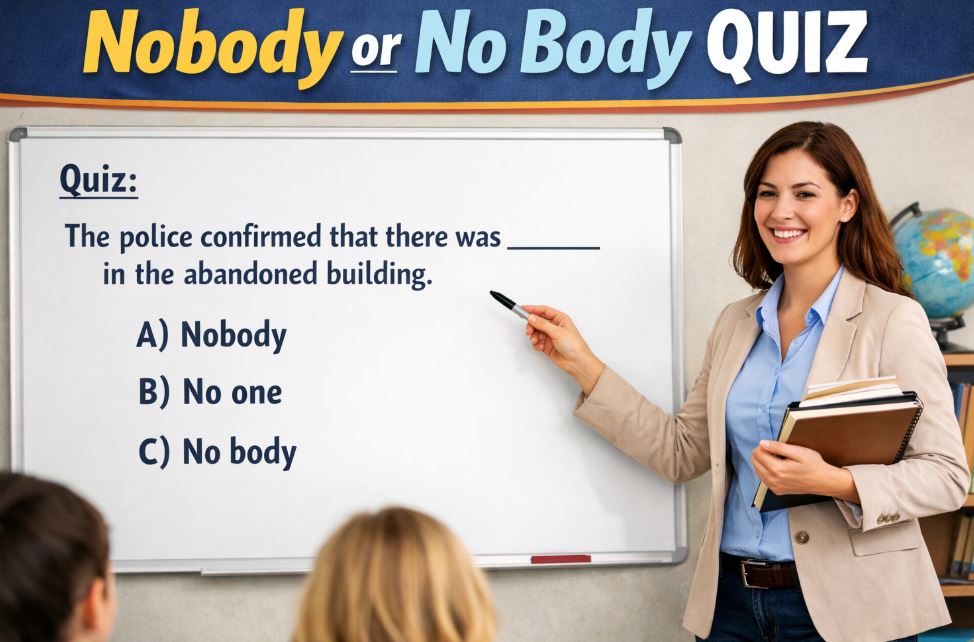
Understanding the difference between “nobody” and “no body” is a common challenge for English learners. Although these two phrases look similar, they carry very different meanings and are used in completely different contexts. This Nobody or No Body Quiz is designed to help you master the distinction through clear explanations and carefully crafted multiple-choice questions.
Whether you’re a student, teacher, competitive exam candidate, or someone improving everyday English, this quiz will sharpen your English grammar skills and boost your confidence in sentence construction.
What Is the Difference Between “Nobody” and “No Body”?
Nobody
Nobody is an indefinite pronoun that means no person.
Example: Nobody answered the phone.
No body
No body is a phrase where “no” modifies the noun “body”, usually referring to a physical body or object.
- Example: There was no body found at the crime scene.
Because they sound identical when spoken, learners often confuse them in writing. This quiz focuses on real-life sentence usage to help you choose the correct form every time.
Nobody or No Body Quiz
Nobody or No Body Quiz (MCQs)
1. _____ knows the truth about what happened last night.
A) No body
B) Nobody
C) None
2. The police confirmed that there was _____ in the abandoned building.
A) Nobody
B) No one
C) No body
3. _____ was willing to take responsibility for the mistake.
A) No body
B) Nobody
C) Not anybody
4. After hours of searching, they realized there was _____ left inside the car.
A) No body
B) Nobody
C) Someone
5. _____ can solve this problem without proper instructions.
A) No body
B) Nobody
C) Any body
6. The doctor said there was _____ injury detected in the scan.
A) Nobody
B) Anybody
C) No body
7. _____ called me while I was away from my phone.
A) No body
B) Nobody
C) Anybody
8. They searched the area thoroughly but found _____ in the river.
A) Nobody
B) No body
C) Someone
9. _____ understands how difficult this situation is.
A) Nobody
B) No body
C) Everybody
10. The report stated clearly that there was _____ present at the scene.
A) Nobody
B) No body
C) Somebody
Answer Key (All Answers Below)
- B) Nobody
- C) No body
- B) Nobody
- A) No body
- B) Nobody
- C) No body
- B) Nobody
- B) No body
- A) Nobody
- B) No body
Read also more related topics: Neither or Either Quiz Test
Why Practice a Nobody or No Body Quiz?
Taking a Nobody or No Body Quiz helps learners:
- Avoid common grammar and writing mistakes
- Improve clarity in formal and academic writing
- Prepare for English exams and quizzes
- Build confidence in sentence structure
- Understand context-based word usage
Regular practice with quizzes like this makes grammar rules easier to remember and apply naturally.
Frequently Asked Questions (FAQs)
What does “nobody” mean in English grammar?
“Nobody” means no person and is used as an indefinite pronoun. It always refers to people, not objects or physical bodies.
When should I use “no body” instead of “nobody”?
Use “no body” when referring to the absence of a physical body, such as in medical, scientific, or investigative contexts.
Are “nobody” and “no one” the same?
Yes, “nobody” and “no one” have the same meaning and are interchangeable in most sentences.
Is “no body” commonly used in everyday English?
“No body” is less common and usually appears in specific contexts like news reports, medical descriptions, or crime investigations.
How can I avoid confusing “nobody” and “no body”?
Focus on meaning:
- If you mean no person, use nobody
- If you mean no physical body, use no body
Conclusion
Mastering the difference between “nobody” and “no body” is a small but important step toward stronger English grammar. This Nobody or No Body Quiz provides practical examples that help you understand real-world usage and avoid common mistakes.
Keep practicing with quizzes like this, and soon these confusing terms will become second nature.