
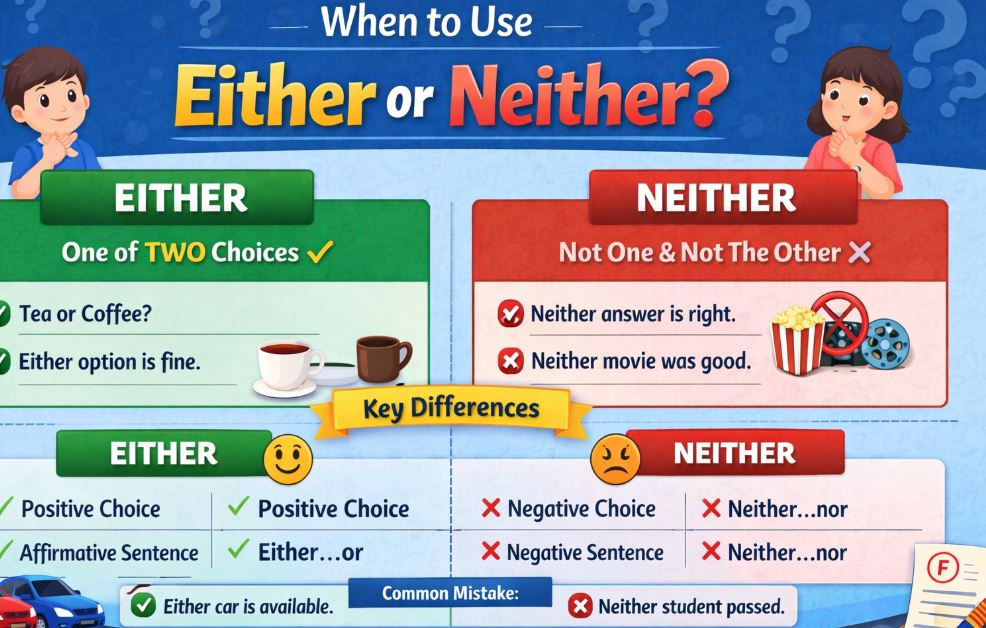
Understanding when to use either or neither is essential for speaking and writing correct English. These two words often confuse learners because they look similar but carry very different meanings. The good news? Once you understand a few simple rules, using either and neither becomes easy and natural.
In this guide, you’ll learn:
What either and neither mean
When to use either
When to use neither
The difference between either and neither with examples
Common mistakes and how to avoid them
This article is written in plain language, with plenty of examples to help you learn faster.
What Does “Either” Mean?
Either means one of two options. It is used when both choices are possible or acceptable, but you are talking about only one of them.
Simple definition:
Either = one or the other (from two choices)
Examples:
You can choose either tea or coffee.
Either answer is correct.
Key point:
Either is mostly used in positive or neutral sentences
It always refers to two options, not more
What Does “Neither” Mean?
Neither means not one and not the other. It is used when both options are rejected.
Simple definition:
Neither = not this one and not that one
Examples:
Neither option is correct.
Neither student passed the test.
Key point:
Neither already has a negative meaning
Do not use another negative word with it
When to Use Either?
You use either when you are talking about one of two choices and both are acceptable.
Use either when:
You are choosing between two things
Both options are possible
You want to show flexibility
Common sentence structures:
1. Either + noun
Either dress looks nice.
Either road will take you to the city.
2. Either of + plural noun
Either of these phones is affordable.
Either of the answers is correct.
3. Either…or (choice structure)
You can either call me or send a message.
She will either study medicine or engineering.
When to Use Neither?
You use neither when both options are not true or not acceptable.
Use neither when:
You reject both choices
You want to express a negative idea clearly
You are talking about only two options
Common sentence structures:
1. Neither + noun
Neither plan worked.
Neither answer is correct.
2. Neither of + plural noun
Neither of the players was ready.
Neither of these solutions helps.
3. Neither…nor (negative pair)
She likes neither tea nor coffee.
He speaks neither French nor Spanish.
Read also more related topics: Each VS Every
Difference Between Either and Neither (With Examples)
Understanding the difference between either and neither is the key to using them correctly.
| Feature | Either | Neither |
|---|---|---|
| Meaning | One of two | Not one and not the other |
| Tone | Positive or neutral | Negative |
| Use | Accepts a choice | Rejects both choices |
| Sentence type | Affirmative | Negative in meaning |
Example comparison:
Either answer is correct. (Both are acceptable)
Neither answer is correct. (Both are wrong)
Either and Neither Examples (From Easy to Advanced)
Basic Examples
You can sit on either chair.
Neither option works for me.
Intermediate Examples
Either of the two routes is safe.
Neither of the excuses sounds convincing.
Advanced Examples
The manager said that either solution would solve the issue.
Neither of the proposed strategies addresses the core problem.
Common Mistakes Learners Make
Mistake 1: Using double negatives
False: Neither of them didn’t come.
True: Neither of them came.
2: Using neither for more than two items
False: Neither of the three options is good.
True: None of the three options is good.
Mistake 3: Wrong verb agreement
False: Neither of the students are ready.
True: Neither of the students is ready.
Either vs Neither vs Both vs Any (Quick Guide)
Either → one of two
Neither → not one and not the other (two)
Both → the two together
Any → one or more (three or more choices)
Quick Rules Cheat Sheet
Use either for one of two choices
Use neither to reject both choices
Never use neither with another negative word
Use either…or and neither…nor correctly
For more than two options, use any or none
Practice: Choose Either or Neither
You may choose ___ option you like.
___ of the answers is correct.
She wants ___ tea nor coffee.
(Answers: 1. either, 2. neither, 3. neither)
FAQs: When to Use Either or Neither?
Can either be used in negative sentences?
Yes, but the sentence meaning remains neutral, not negative.
Is neither always singular?
Yes, neither is treated as singular in formal English Grammar.
Can either and neither refer to more than two things?
No. They are used only for two options.
Conclusion
Now you clearly understand when to use either or neither. Remember:
Either accepts one of two choices
Neither rejects both choices
With regular practice and attention to sentence structure, you’ll use these words confidently in both writing and speaking.