
Many English learners get confused when using either and neither, mainly because these two words are similar in appearance and often appear in similar sentence structures. Even though they seem tricky at first, the good news is that their meanings and uses are actually quite simple once you learn the basics. Understanding the difference between them can make your sentences clearer, more natural, and grammatically correct.
This guide will walk you through everything you need to know about ‘either’ and ‘neither’ in an easy and friendly way. You’ll learn what each word means, how to use them in everyday sentences, and how to avoid the common mistakes learners usually make.
To help you build confidence, the guide also includes plenty of practical examples, explanations, and answers. With a little practice, you’ll be able to choose the right word effortlessly and use both terms correctly in conversations and writing.
Meaning of “Either”
Either refers to one of two choices.
It is used in affirmative (positive) sentences.
Uses of “Either”
- To choose between two options
- To agree in a negative sentence (paired with “too”)
- To mean “any one of the two”
Examples
- You can choose either tea or coffee.
Meaning: One of the two is okay. - I don’t like spicy food.
— I don’t either.
Agreeing with a negative sentence. - Either answer is correct.
Both options are acceptable, but you pick one.
Meaning of “Neither”
Neither means not one and not the other.
It is used to express zero options or complete rejection.
Uses of “Neither”
- To reject both choices
- To agree in a negative sentence (paired with “nor”)
- To connect two negative items
Examples
Neither tea nor coffee is available.
Meaning: Both are unavailable.
I can’t swim.
— Neither can I.
Agreeing with a negative statement.
Neither answer is correct.
Both options are wrong.
Either vs. Neither (Quick Difference)
| Word | Meaning | Sentence Direction |
| Either | One of two | Positive choice |
| Neither | Not one, not the other | Negative choice |
✔ Either = one is okay
✔ Neither = none is okay
Examples with Answers (Practice Section)
Example 1
Choose the correct word: Either / Neither
___ option works for me.
Answer: Either
(You are okay with any one of the two.)
Example 2
Choose the correct phrase:
I don’t like football.
— I don’t ___.
Answer: either
(Use “either” to agree with a negative sentence.)
Example 3
Fill in the blank:
___ John nor Peter came to class.
Answer: Neither
(Both were absent.)
Example 4
You can take ___ Bus A or Bus B to get to the market.
Answer: either
(Both are possible choices.)
Example 5
___ of the dresses fit me, so I didn’t buy any.
Answer: Neither
Example 6
I don’t like morning classes.
— ___ do I.
Answer: Neither
Read also more related topics: Anybody VS nobody
Quick Tips to Remember
- Either = one
- Neither = none
- Either…or = positive structure
- Neither…nor = negative structure
- After “neither,” verbs are usually singular
- Neither boy is ready. ✔
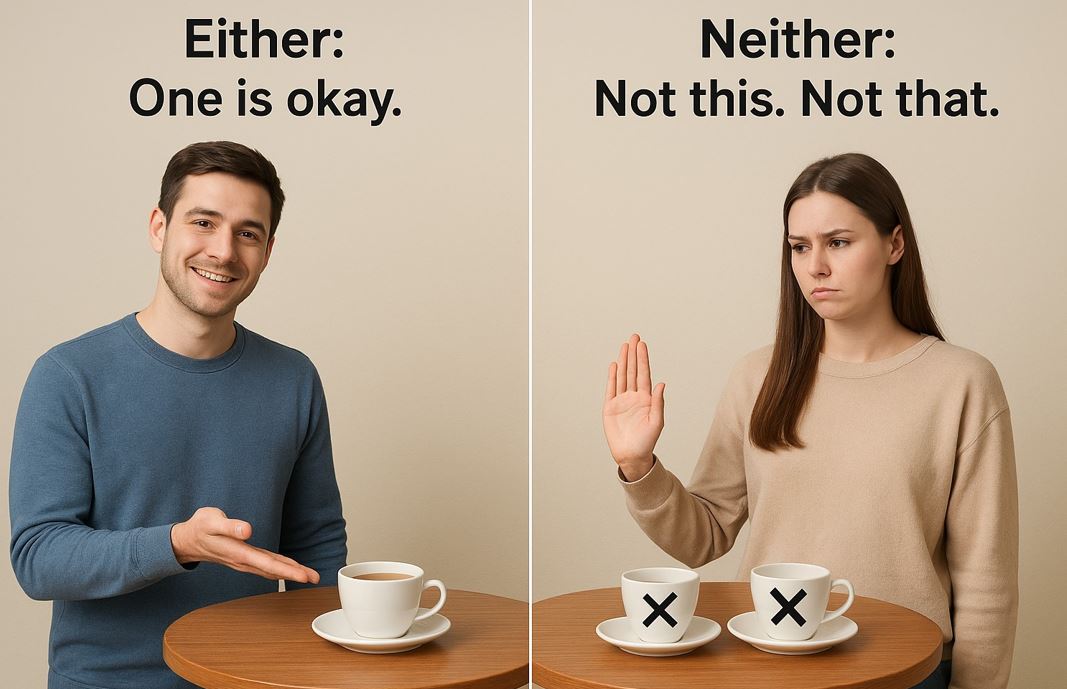
Fun Meme to Remember (Text Version)
Either: “Pick one, both are good!”
Neither: “Nope. Not this. Not that. Nothing!”
FAQs About “Either” and “Neither”
What is the main difference between “either” and “neither”?
Either is used to talk about one of two choices, usually in a positive way.
Neither is used to talk about zero choices, meaning not one and not the other.
Can “either” be used in negative sentences?
Yes, but only when agreeing with a negative sentence.
Example:
“I don’t like cola.” — “I don’t either.”
Is “neither…nor” always negative?
Yes. The structure neither…nor is always used to show that both options are negative or rejected.
Example: “Neither the movie nor the book was interesting.”
Should the verb after “neither” be singular or plural?
Usually, the verb is singular because “neither” refers to not one.
Example: “Neither answer is correct.”
Can I use “either…or” for more than two options?
Traditionally, “either…or” is used for two choices, but in casual speech some people use it for more. For clear grammar, stick to two options.
When do we use “neither” alone in a sentence?
You use it to respond to a negative sentence:
Example:
“I can’t dance.” — “Neither can I.”
Is “either” always positive?
Not always.
It’s positive when talking about choices:
“You can take either road.”
But it becomes “negative” when used after “don’t”:
“I don’t like pizza.” — “I don’t either.”
Can “either” and “neither” be used as pronouns?
Yes!
Either = one of two
Neither = none of the two
Example:
“Either is fine.” / “Neither is true.”
Can I start a sentence with “neither”?
Absolutely.
Example: “Neither of them knew the answer.”
Why do learners confuse “either” and “neither”?
Because they look similar and sometimes appear in the same situations.
A simple trick:
Either = one
Neither = none
Conclusion
“Either” and “Neither” may feel confusing at first, but once you remember that either is positive and neither is negative, everything becomes easier.
Use “either” when one of two choices is acceptable, and “neither” when both are rejected. Keep practicing with the examples, and soon these words will naturally fit into your daily English speaking and writing.