
If you have ever paused mid-sentence wondering whether you are studying “English” or “English something else,” you are not alone. Every year, thousands of students staring at course selection forms ask the same question: what actually separates English Language from English Literature? They share a name, a classroom, and sometimes even a textbook — yet they test completely different skills.
This guide breaks down exactly how these two subjects differ, with real examples, level-specific comparisons (GCSE, A Level, and IB), and practical advice to help you pick the right path.
What Is English Language?
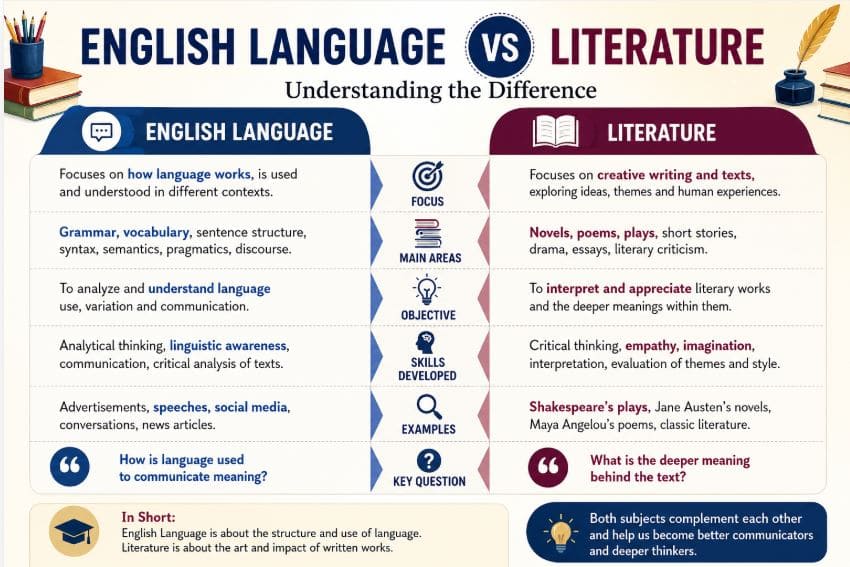
English Language is the study of how English works as a communication system. It focuses on structure, function, and usage rather than storytelling. Students examine:
- Grammar, syntax, and sentence construction
- Phonetics and how sounds form words
- Semantics (meaning) and pragmatics (context-based meaning)
- Rhetorical and persuasive techniques in speeches, adverts, and articles
- How language changes across regions, time periods, and social groups (sociolinguistics)
In short, English Language treats language itself as the object of study — much like a scientist studying an organism.
What Is English Literature?
English Literature is the study of written creative works — novels, poems, plays, and short stories — and the deeper meaning, themes, and artistry behind them. Students explore:
- Themes, symbolism, and narrative structure
- Character development and authorial intent
- Historical and cultural context of a text
- Literary devices such as metaphor, irony, and foreshadowing
- Critical interpretation and analysis of classic and contemporary works
While English Language asks “how does this text function linguistically?”, English Literature asks “what does this text mean, and why does it matter?”
Define Language and Literature: The Core Distinction
At the simplest level:
- Language is the system — the rules, sounds, words, and structures that allow communication to happen.
- Literature is the product — the creative and artistic use of that system to tell stories, express emotion, or explore ideas.
Think of language as the toolkit and literature as the furniture built from it. You cannot have literature without language, but you can study language without ever touching a novel or poem.
Difference Between Language and Literature With Examples
Examples make the distinction much clearer than definitions alone.
1 Example : Analyzing a newspaper headline
An English Language student might examine why a tabloid uses short, punchy words and emotive language to persuade readers, focusing on technique and audience impact.
2 Example : Analyzing a Shakespeare sonnet
An English Literature student would explore the sonnet’s themes of love or mortality, its use of iambic pentameter, and how it reflects Elizabethan values.
3 Example : A political speech
Language study looks at rhetorical devices, tone, and persuasive strategy. Literature study, if the speech is treated as a literary text, would examine its historical significance and symbolic meaning.
4 Example : Everyday conversation
Language study might analyze regional dialect, slang, or how meaning shifts based on context. Literature has little interest in casual conversation unless it appears within a novel or play as dialogue crafted by an author.
English Language and Literature Subject Comparison Table
| Aspect | English Language | English Literature |
|---|---|---|
| Focus | Structure and function of language | Meaning and artistry of written works |
| Core Skills | Grammar, linguistics, rhetorical analysis | Textual analysis, critical interpretation |
| Typical Texts | Speeches, articles, transcripts, adverts | Novels, poems, plays, short stories |
| Key Question | How does language work? | What does this text mean? |
| Assessment Style | Analytical and comparative writing | Essay-based critical analysis |
| Career Relevance | Journalism, linguistics, teaching, copywriting | Publishing, academia, creative writing, law |
What Is the Difference Between English Language and English Literature at GCSE?
At GCSE level, both subjects are usually compulsory in UK schools, and the distinction is more approachable:
- English Language GCSE tests reading comprehension, creative and transactional writing, and spoken language skills. Students analyze unseen non-fiction and fiction extracts and write their own persuasive or narrative pieces.
- English Literature GCSE requires studying a fixed set of texts — typically a Shakespeare play, a 19th-century novel, a modern text, and a poetry anthology — and writing essays analyzing themes, characters, and context.
The GCSE Language exam rewards clarity, technique, and control of expression. The Literature exam rewards depth of interpretation and the ability to reference specific quotations and context.
What Is the Difference Between English Language and English Literature at A Level?
A Level marks a bigger fork in the road, since these become separate optional subjects (or can be combined as “English Language and Literature” in some exam boards).
- English Language A Level dives into linguistic theory, child language acquisition, language change over time, and discourse analysis. Independent investigation projects are common, where students research a real-world language issue.
- English Literature A Level demands close reading of complex texts, comparative essays between multiple works, and engagement with literary criticism and theoretical perspectives.
Some exam boards also offer a combined English Language and Literature A Level, which blends creative writing, linguistic analysis, and literary study — ideal for students who enjoy both sides but do not want to choose exclusively.
English Language and Literature IB Past Papers: What to Expect
In the International Baccalaureate (IB), the subject is officially called Language A: Language and Literature, combining both strands rather than separating them entirely. Reviewing past papers reveals the structure clearly:
- Paper 1 typically involves analyzing unseen non-literary texts (such as advertisements, articles, or speeches), testing language analysis skills.
- Paper 2 requires comparative essays on literary works studied during the course, testing literature analysis skills.
- The Higher Level (HL) essay and individual oral assessments ask students to explore a literary or language-based question in depth, often connecting a text to a global issue.
Practicing past papers is one of the most effective ways to understand how examiners expect language and literary analysis to be woven together in IB assessments, since the subject deliberately merges both disciplines rather than testing them in isolation.
Language and Literature Subject: Which Should You Choose?
Choosing between the two (where a choice exists) often comes down to personality and career goals.
Choose English Language if you enjoy:
- Breaking down how persuasion and tone work
- Analyzing real-world texts like news articles or social media
- Understanding grammar rules and how language evolves
- Careers in journalism, marketing, teaching (TESOL/TEFL), or linguistics
Choose English Literature if you enjoy:
- Getting lost in novels, plays, and poetry
- Debating themes, symbolism, and authorial choices
- Writing essays that build an interpretive argument
- Careers in publishing, academia, creative writing, or law
Many students find they enjoy both, which is exactly why combined qualifications like IB Language A or the UK’s combined A Level exist. If you want to be a good English teacher, then you have to know on how to become a good English Teacher.
Frequently Asked Questions
Is English Literature harder than English Language?
Neither subject is universally “harder” — difficulty depends on individual strengths. Literature demands strong essay-writing and interpretive skills, while Language demands precision in analyzing structure, grammar, and rhetorical technique.
Can you study both English Language and Literature together?
Yes. Many exam boards and the IB program offer combined courses that blend linguistic analysis with literary study, giving students exposure to both skill sets.
Which subject is better for a journalism career?
English Language is generally more directly relevant to journalism, since it develops skills in rhetoric, tone, audience awareness, and real-world text analysis.
Do universities prefer English Literature over English Language for humanities degrees?
Not necessarily. Many universities value either subject, though a straight English Literature degree usually expects A Level or IB Literature, while a Linguistics degree often favors English Language background.
What is the main difference between language and literature in one sentence?
Language is the system used to communicate, while literature is the creative and artistic application of that system through written works.